
Uncategorized
The Science Behind Cocaine Hydrochloride: Chemistry & Research
Nov
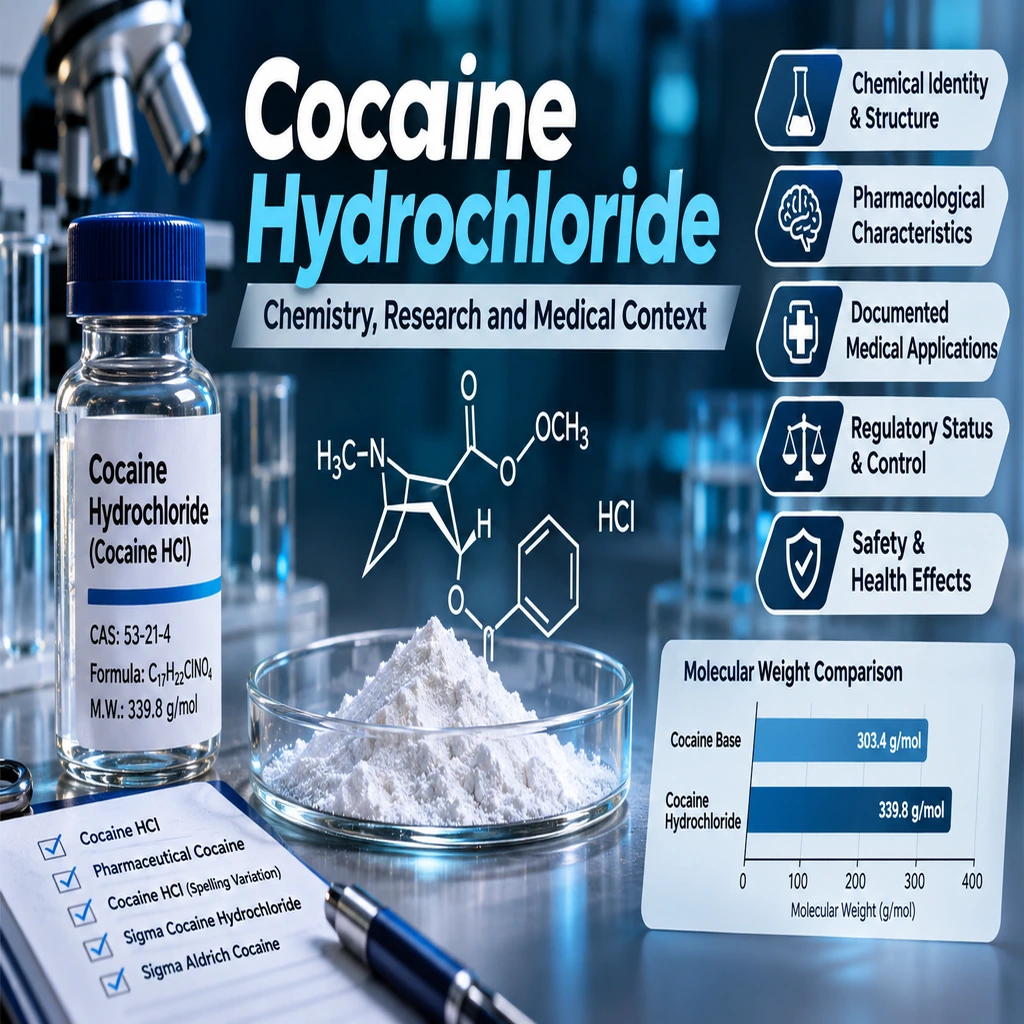
The Science Behind Cocaine Hydrochloride: Chemistry, Research and Medical Context
Scientists study chemical compounds across several disciplines, including organic chemistry, pharmacology, toxicology and pharmaceutical research. Cocaine hydrochloride is one such compound. Scientific databases and medical literature describe its chemical identity, molecular structure and pharmacological characteristics.
Cocaine hydrochloride is the salt form of cocaine, a naturally occurring tropane alkaloid that occurs in the coca plant. However, researchers discuss this compound within a limited medical context, and strict regulations control its use. Therefore, readers should understand the difference between chemical identity, pharmaceutical formulation and clinical authorization.
Scientific sources cover this compound’s chemical characteristics, limited medical context and potential health risks. Together, these topics help explain its place in pharmaceutical science.
Understanding Cocaine Hydrochloride
Cocaine hydrochloride is the hydrochloride salt form of cocaine. Cocaine is a naturally occurring alkaloid found in the leaves of Erythroxylum coca, a plant native to South America. Specifically, it belongs to the tropane alkaloid family, whose members have distinctive chemical structures.
Scientists and pharmaceutical professionals commonly use the term Cocaine HCl as an abbreviation for cocaine hydrochloride. Nevertheless, the full chemical name usually provides greater clarity in scientific and pharmaceutical discussions.
Readers should also distinguish a chemical compound from a finished pharmaceutical formulation. For example, a scientific database may identify a substance and describe its molecular properties. However, that information does not establish that every product containing the substance has approval or is suitable for medical use.
Chemical Identity and Molecular Structure
Researchers identify cocaine hydrochloride through its molecular formula, molecular weight and chemical identifiers. These characteristics help them distinguish related chemical forms and maintain consistent scientific documentation.
- Chemical name: Cocaine hydrochloride
- Common abbreviation: Cocaine HCl
- Parent compound: Cocaine
- Chemical class: Tropane alkaloid salt
- Molecular formula: C17H22ClNO4
- Molecular weight: Approximately 339.8 g/mol
- CAS Registry Number: 53-21-4
The molecular formula shows which elements the compound contains and how many atoms of each element it represents. Meanwhile, molecular weight expresses the mass of one mole of the substance. Researchers use these details for chemical identification and scientific documentation.
Researchers distinguish the hydrochloride salt from cocaine base because the two forms have different molecular properties. Their molecular weights differ because the hydrochloride form includes the hydrochloride component in its chemical composition.
How the Molecular Forms Differ
The molecular weight of cocaine base is approximately 303.4 g/mol, whereas cocaine hydrochloride has a molecular weight of approximately 339.8 g/mol. As a result, this comparison shows how a compound’s chemical form affects its molecular characteristics.
When discussing a chemical substance, writers should specify whether they mean the parent compound or its hydrochloride salt. In this way, accurate naming helps prevent confusion in research publications, chemical databases and pharmaceutical documentation.
Research-Based Molecular Weight Comparison
The table below presents the molecular-weight values for cocaine base and cocaine hydrochloride side by side.
| Chemical form | Molecular weight |
|---|---|
| Cocaine base | 303.4 g/mol |
| Cocaine hydrochloride | 339.8 g/mol |
Cocaine HCl and Cocaine HCI: Understanding the Names
Online searches and scientific discussions may show different spellings and abbreviations. For clarity, Cocaine HCl is a common abbreviation for cocaine hydrochloride. In addition, some search queries use Cocaine HCI because lowercase “l” and uppercase “I” can look similar in certain fonts.
Readers should not automatically interpret these spelling variations as separate chemical substances. Instead, they can check the full chemical name, molecular formula and recognized chemical identifiers to establish a compound’s identity more reliably.
For scientific writing, authors should generally use the full name cocaine hydrochloride for clarity. After introducing that name, they can use the abbreviation Cocaine HCl.
Pharmacological Characteristics
Cocaine affects several neurotransmitter systems in the central nervous system. Neurotransmitters act as chemical messengers, allowing nerve cells to communicate with one another. In turn, their activity influences processes such as mood, alertness, motivation and movement.
Researchers describe cocaine’s stimulant activity and its effects on dopaminergic and noradrenergic neurotransmission. These effects help explain both the compound’s pharmacological significance and its substantial health risks.
Dopamine and Noradrenaline
Dopamine plays a role in reward processing, motivation and several movement-related functions. Meanwhile, noradrenaline contributes to alertness and the body’s response to stress. Cocaine affects the transport systems that regulate these neurotransmitters.
Changes in neurotransmitter activity can affect several biological systems. For example, these effects may involve the brain, cardiovascular system and other parts of the body. Consequently, toxicologists and pharmacological researchers consider cocaine an important subject of study.
Why Pharmacological Research Is Important
Pharmacological research examines the ways chemical substances interact with biological systems. Through this work, scientists can understand mechanisms of action, potential medical applications and adverse effects.
However, identifying a pharmacological mechanism does not prove that a substance is safe for general use. Instead, researchers and regulators must consider scientific understanding, clinical evidence and regulatory authorization separately.
Documented Medical Applications
Medical literature describes a limited role for cocaine hydrochloride in certain regulated topical anaesthetic formulations. In particular, clinicians have used specific formulations in surgical procedures involving areas such as the nose and throat.
A topical anaesthetic reduces sensation in a particular area. However, scientific references describe only a specific medical application; they do not support general or unsupervised use.
Labels for particular cocaine hydrochloride formulations specify prescription restrictions, clinical warnings and limits on the routes for which clinicians may use those preparations.
Readers must interpret regulatory details carefully. For example, a drug-label document in a database does not, by itself, prove that the FDA has approved or authorized every product carrying the same chemical name.
Pharmaceutical Documentation and Quality Information
Pharmaceutical professionals use documentation to describe medicinal ingredients, formulations and relevant product information. Such records may include details about chemical identity, composition, labeling, storage and regulatory status.
For controlled substances, accurate documentation and regulatory oversight are especially important. Therefore, readers should interpret scientific information in the context of the particular substance and formulation under discussion.
- Substance identity: The recognized chemical name and identifiers used to describe a compound.
- Composition: Information about active and inactive ingredients in a particular formulation.
- Product labeling: Clinical restrictions, warnings and other information associated with a medicinal product.
- Regulatory information: Applicable authorization and legal requirements.
- Scientific documentation: Records that support research and pharmaceutical evaluation.
These categories serve different purposes. For instance, a chemical reference differs from a finished product label. Likewise, neither document replaces an official regulatory decision.
Comparison of Chemical and Pharmaceutical Terms
The terminology surrounding cocaine hydrochloride can be confusing because writers sometimes use chemical names, abbreviations and pharmaceutical terms together. To clarify these differences, the following table explains each term in its proper context.
| Term | Meaning | Scientific or Pharmaceutical Context |
|---|---|---|
| Cocaine | The parent tropane alkaloid compound | Used when discussing the parent chemical structure and pharmacology |
| Cocaine Hydrochloride | The hydrochloride salt form of cocaine | Has its own molecular formula and molecular weight |
| Cocaine HCl | Common abbreviation for cocaine hydrochloride | Shortened terminology used in scientific discussions |
| Cocaine HCI | Spelling variation encountered in searches | Should be checked against the full chemical name |
| Topical Anaesthetic | A preparation used to reduce sensation at a particular surface | Describes a medical function, not a chemical identity |
| Pharmaceutical Formulation | A prepared medicinal product containing specified ingredients | Its quality and authorization must be evaluated separately |
| Active Pharmaceutical Ingredient | The ingredient responsible for a medicinal product’s intended activity | One part of pharmaceutical formulation and documentation |
Overall, this comparison highlights an important distinction: a chemical name identifies a substance, whereas a pharmaceutical term may describe its function, preparation or regulatory context.
Safety and Potential Health Effects
Cocaine carries significant health risks. Reported effects include restlessness, irritability, anxiety, paranoia, increased heart rate and serious cardiovascular complications. In severe cases, exposure can also lead to seizures and life-threatening toxicity.
Scientific and public-health researchers also examine cocaine’s stimulant effects and dependence potential. Therefore, these findings matter when considering its pharmacological activity and broader health implications.
Potential health concerns include:
- Changes in heart rate and blood pressure
- Cardiovascular complications
- Neurological and psychological effects
- Anxiety, agitation and paranoia
- Dependence and substance-use disorders
- Serious toxicity and potentially life-threatening complications
Health risks can vary according to individual circumstances and exposure. Nevertheless, a limited medical application does not make unsupervised exposure safe. Any legitimate clinical use must follow applicable prescribing requirements, product labeling and professional medical oversight.
Regulatory Status and Controlled-Substance Considerations
International and national drug-control frameworks regulate cocaine. For example, the United States Drug Enforcement Administration classifies cocaine as a Schedule II controlled substance.
This controlled-substance classification reflects the need for strict oversight. Depending on the jurisdiction, legal requirements may govern manufacturing, possession, prescribing, distribution, storage and professional handling.
Why Regulatory Authorization Matters
Regulatory authorization remains separate from chemical identity. For example, a scientific database may describe a substance without confirming that regulators have approved every product containing it for medical use.
Similarly, a drug-label record does not automatically prove that a particular product has received authorization from a national regulator. Therefore, readers should consult the relevant official authority when assessing a medicinal product’s status.
Ultimately, understanding these differences helps readers avoid inaccurate claims about pharmaceutical quality, safety and clinical suitability.
Conclusion
Cocaine hydrochloride is a documented chemical compound with a defined molecular identity and an established place in pharmaceutical and pharmacological research. Scientific literature examines its relationship to the parent compound, its molecular properties and its effects on neurotransmitter systems.
Finally, readers must consider its limited medical context alongside its health risks and controlled-substance status. Chemical identity, pharmaceutical formulation, clinical use and regulatory authorization represent different considerations. For this reason, understanding these distinctions is essential when interpreting pharmaceutical and chemical information.
