Uncategorized
Ketamine Nasal Spray: Research, Brain Effects & Safety
Nov
Ketamine and Modern Medicine: Exploring New Directions in Neuroscience and Mental Health
Ketamine has become an important subject in modern medical research because of its established role in anaesthesia and its emerging applications in neuroscience and mental health. Researchers now examine how this medicine interacts with the brain, particularly its effects on glutamate signalling and communication between nerve cells. These investigations have contributed to a wider discussion about treatment-resistant depression and other complex mental health conditions.
One area receiving attention is Ketamine Nasal Spray. Intranasal formulations appear in clinical research and medical literature, although different products can contain different forms of ketamine and follow different regulatory requirements. Understanding these distinctions helps readers interpret the available evidence accurately.
This article explores ketamine’s pharmacological background, its role in neuroscience, the difference between ketamine and esketamine, and the clinical and regulatory considerations surrounding nasal formulations.
The Evolution of Ketamine in Modern Medicine
Researchers originally developed ketamine as an anaesthetic medicine. Its ability to produce anaesthesia while generally maintaining certain protective airway reflexes helped establish its place in medical practice. Over time, clinicians also began investigating its effects on pain perception, consciousness, and brain activity.
Many traditional medicines primarily influence one neurotransmitter system. Ketamine, however, interacts with several pathways involved in communication between nerve cells. Its best-known pharmacological action involves blocking the N-methyl-D-aspartate (NMDA) receptor, which forms part of the glutamate signalling system.
Research into these effects expanded when scientists began investigating whether ketamine-related medicines could influence symptoms in people who had not responded adequately to conventional depression treatments. This work helped establish a new direction in psychiatric medicine, particularly in the study of treatment-resistant depression.
However, new clinical applications do not mean that every ketamine formulation has the same evidence, approval status, or safety profile. The formulation, route of administration, clinical setting, and patient’s medical circumstances all influence how professionals evaluate a medicine.
How Ketamine Interacts With the Brain
Ketamine’s best-known mechanism involves the NMDA receptor, which glutamate activates. Glutamate serves as the primary excitatory neurotransmitter in the central nervous system. It plays an important role in learning, memory, neural plasticity, and communication between brain cells.
Ketamine can alter patterns of neural signalling by influencing NMDA receptor activity. Researchers also study its downstream effects on other signalling pathways that may contribute to changes in synaptic connections. These processes matter because synaptic plasticity helps the brain adapt and form new connections.
Glutamate and Neural Communication
Glutamate helps nerve cells communicate with one another. The brain carefully regulates its activity because excessive or insufficient signalling can affect normal brain function. NMDA and AMPA receptors serve as two important components of this system, and researchers have investigated both in studies involving ketamine.
Scientists continue to examine how changes in glutamate signalling may contribute to the effects observed in clinical studies. Although researchers have proposed several mechanisms, they still need to understand the full relationship between receptor activity, neural plasticity, and changes in mood.
Neuroplasticity and Synaptic Connections
Neuroplasticity describes the brain’s ability to adapt by changing the strength or organisation of connections between neurons. Some research suggests that ketamine-related signalling may influence pathways associated with synaptic formation and function.
These findings have increased interest in the relationship between glutamate activity and mood disorders. Nevertheless, laboratory findings and early clinical observations do not prove that a particular formulation will produce the same results in every patient.
Ketamine and the Changing Landscape of Mental Health Research
One of the most widely discussed areas of ketamine research involves treatment-resistant depression. This term generally describes depression that has not responded adequately to multiple standard treatment approaches. Researchers have investigated ketamine-related medicines because their mechanisms differ from those of many commonly prescribed antidepressants.
Conventional antidepressants often influence serotonin, norepinephrine, or other neurotransmitter systems. Ketamine-related treatments have a different pharmacological profile, with a particular focus on glutamate signalling. This difference has encouraged researchers to investigate whether alternative mechanisms can contribute to new approaches for people with treatment-resistant depression.
Clinical evidence requires careful interpretation according to the exact medicine that researchers studied. For example, the FDA-approved nasal medicine SPRAVATO contains esketamine, which represents the S-enantiomer of ketamine. Its clinical trial results do not provide direct evidence for compounded racemic ketamine nasal spray.
What Clinical Research Shows About Esketamine
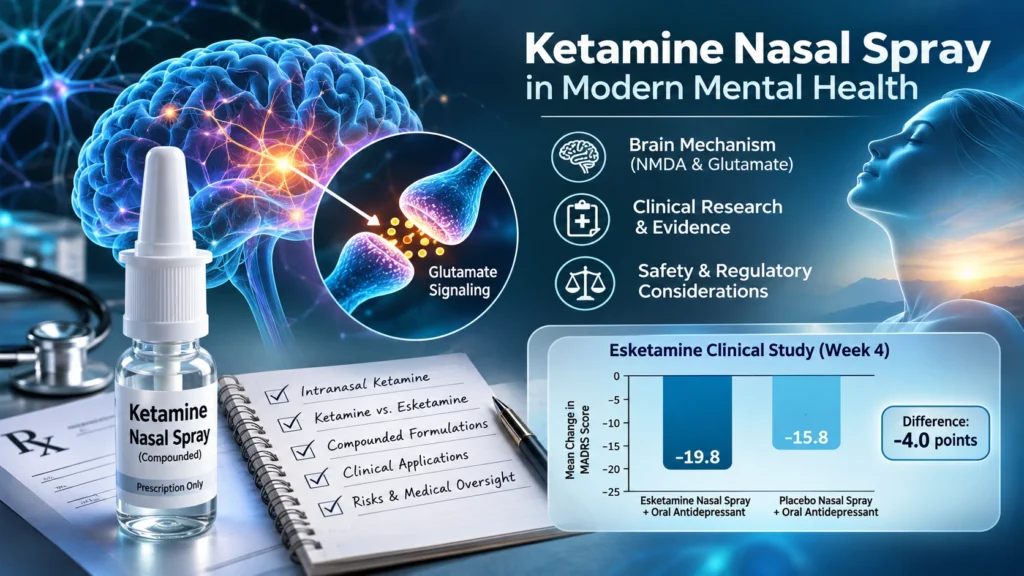
One clinical study in the FDA prescribing information for SPRAVATO examined adults with treatment-resistant depression. Participants received either esketamine nasal spray alongside an oral antidepressant or placebo nasal spray alongside an oral antidepressant. At the end of the four-week study period, the esketamine group showed a greater average reduction in Montgomery-Åsberg Depression Rating Scale (MADRS) scores.
The reported least-squares mean change reached -19.8 points for the SPRAVATO group and -15.8 points for the placebo nasal spray group. Researchers reported a difference of -4.0 points between the groups. These findings relate specifically to the studied esketamine treatment and trial conditions.
Esketamine Clinical Study (Week 4)
Mean change in MADRS depression score
Esketamine Nasal Spray + Oral Antidepressant
Placebo Nasal Spray + Oral Antidepressant
Difference between groups
-4.0 points
This chart illustrates how clinical researchers measure changes in depressive symptoms. Readers should not use these results to make direct claims about other formulations. Differences in active ingredients, formulation, study design, and clinical settings can influence outcomes.
Understanding Different Nasal Formulations
The term Nasal Ketamine sometimes appears as a broad description in online discussions, but it can refer to different products. These may include FDA-approved esketamine nasal spray and compounded preparations containing racemic ketamine. Although both use the nasal route, they are not interchangeable.
Intranasal administration delivers a medicine through the nasal passages. A product’s formulation and other characteristics can influence its absorption. Therefore, the route alone does not establish that two products share equivalent effects or clinical evidence.
FDA-Approved Esketamine Nasal Spray
SPRAVATO is a prescription nasal spray that contains esketamine. The FDA has approved it for certain adults with treatment-resistant depression and for depressive symptoms in adults with major depressive disorder accompanied by acute suicidal ideation or behaviour, under the conditions described in its prescribing information.
Its use involves specific safety requirements. A healthcare professional supervises administration and monitors patients afterward because the medicine carries risks that include sedation, dissociation, respiratory depression, and increased blood pressure. SPRAVATO also follows a restricted distribution and safety programme.
Compounded Racemic Ketamine Nasal Spray
Compounded ketamine nasal spray represents a different type of preparation. Compounding involves combining, mixing, or altering ingredients to create a medicine for an individual patient when certain requirements apply. A compounded preparation may contain racemic ketamine, which includes both R- and S-enantiomers.
Compounded medicines do not receive FDA approval in the same way as commercially approved medicines. The FDA does not review each compounded preparation for safety, effectiveness, and quality before marketing. This distinction matters when readers evaluate claims about a compounded Ketamine Spray or another intranasal preparation.
Search phrases such as order ketamine nasal spray compounded may appear in online discussions. However, these phrases do not establish that a product has FDA approval or that it suits a particular person. Ketamine is a controlled medicine in the United States, and legitimate clinical use requires appropriate medical oversight and compliance with applicable laws.
Ketamine and Esketamine: Understanding the Scientific Difference
Ketamine and esketamine are closely related, but they are not identical substances. Ketamine used in many medical settings is a racemic mixture containing two enantiomers, while esketamine contains the S-enantiomer. This chemical distinction matters when researchers and healthcare professionals interpret clinical evidence and regulatory approvals.
The following table summarises important differences between these two categories.
| Feature | Racemic Ketamine | Esketamine |
|---|---|---|
| Chemical composition | Contains R- and S-enantiomers | Contains the S-enantiomer |
| Medical use | Established anaesthetic use; other uses depend on clinical context and applicable regulations | FDA-approved nasal product for specified psychiatric indications |
| Nasal formulation | Compounded nasal preparations may be made under applicable compounding requirements | Available as the FDA-approved SPRAVATO nasal spray |
| Regulatory status | Compounded preparations are not FDA-approved products | SPRAVATO is an FDA-approved prescription medicine |
| Clinical evidence | Evidence varies by formulation, indication, and study | Supported by clinical trials conducted for its approved indications |
| Clinical supervision | Requires appropriate prescribing and medical oversight | Administered under healthcare professional supervision with required monitoring |
This comparison highlights why the terms Intranasal Ketamine, Ketamine Nose Spray, and esketamine nasal spray should not describe the same approved medicine. Evidence for one formulation cannot automatically establish the effectiveness or safety of another.
Safety Considerations and Potential Risks
Ketamine can produce significant effects on the central nervous system. Depending on the formulation, exposure, and individual circumstances, reported effects may include dizziness, sedation, changes in perception, nausea, increased blood pressure, and impaired coordination. Certain clinical situations can also involve more serious concerns.
Medical professionals consider a patient’s health history, current medicines, and potential risk factors before deciding whether a ketamine-related treatment is appropriate. They also determine monitoring requirements according to the medicine and its approved or intended clinical use.
FDA Safety Communications on Compounded Ketamine
The FDA has issued safety communications about compounded ketamine products. In February 2022, the agency alerted healthcare professionals to potential risks associated with compounded ketamine nasal spray. Later, in October 2023, it issued another warning concerning potential risks associated with compounded ketamine products, including oral formulations used for psychiatric disorders.
These communications matter because compounded products do not undergo the same premarket FDA review as approved
