
Buy crystal meth
Blue Meth: Fiction, Science, and the Reality Behind Its Reputation
Nov
The Blue Meth Phenomenon: Fiction, Science, and the Reality Behind Its Reputation
Few fictional substances have become as recognizable in modern television culture as blue meth. Its unusual appearance, association with the television series Breaking Bad, and connection with the fictional character Walter White have made it a frequently discussed subject online. Over time, searches such as blue meth, blue crystal methamphetamine, and is blue meth real have developed into a mixture of entertainment-related curiosity and questions about the actual science of methamphetamine.
However, the popular image of blue meth does not tell the complete scientific story. Fictional portrayals, online discussions, and real-world drug information are not always consistent. A blue appearance does not establish chemical identity, purity, strength, or safety. Understanding this distinction is important when discussing methamphetamine and its effects on public health.
The subject also raises wider questions about how entertainment influences public understanding of drugs, how misinformation spreads online, and why accurate medical information matters. Looking at the topic through these perspectives provides a more meaningful understanding than focusing on appearance alone.
How Blue Meth Became a Recognizable Part of Popular Culture
The popularity of blue meth is closely associated with Breaking Bad. The television series introduced a fictional version of crystal methamphetamine with a distinctive blue appearance. This visual detail became an important part of the show’s identity and helped distinguish its fictional storyline from other television dramas.
The unusual colour also created curiosity among viewers. People began searching for explanations about whether blue crystal methamphetamine exists, whether crystal meth can naturally appear blue, and whether the television portrayal was scientifically accurate.
Popular culture can influence how people understand complicated subjects. A distinctive image can become more memorable than the scientific facts behind it. This is particularly relevant when fictional entertainment portrays illegal substances, medical conditions, or criminal activity.
In the case of blue meth, the fictional colour should not be treated as a reliable scientific description. Real-world methamphetamine is a dangerous stimulant, and its appearance alone cannot establish what a substance contains.
What Is Blue Meth in the Context of Real-World Science?
When people ask what is blue meth, they are often referring to the fictional blue-coloured substance shown in Breaking Bad. In real-world discussions, the phrase may also be used informally when referring to methamphetamine or crystal meth.
Methamphetamine is a powerful synthetic central nervous system stimulant. It affects brain chemicals involved in attention, motivation, movement, and reward. It has a high potential for addiction and can cause serious physical and psychological complications.
According to the National Institute on Drug Abuse (NIDA), crystal methamphetamine can resemble glass fragments or shiny, bluish-white rocks. The Drug Enforcement Administration (DEA) also describes crystal meth as glass-like fragments or shiny bluish-white rocks of varying sizes.
These descriptions are important because they explain why the phrase blue crystal methamphetamine appears in public information. However, they do not establish that a distinctly blue substance is a special or reliably identifiable form of methamphetamine.
There is also an important distinction between a descriptive colour and a verified chemical identity. A substance cannot be reliably identified through a photograph, colour, texture, or online description. Laboratory analysis is required to establish its composition.
Why the Colour of a Substance Can Create Confusion
Colour can influence how people interpret an unfamiliar substance. In entertainment, a distinctive colour can communicate uniqueness, identity, or importance without requiring a detailed explanation. In scientific and medical contexts, however, colour is only one observable characteristic and cannot replace chemical testing.
Questions such as can meth be blue, is crystal meth blue, and why is meth blue often come from the assumption that colour has a direct relationship with chemical composition. That assumption is unreliable.
Different substances can have similar appearances, while substances containing the same active chemical may look different. Contaminants, environmental conditions, and other unknown materials can also affect appearance. None of these visible characteristics provides a dependable indication of safety.
This is why public health organizations emphasize verified information rather than visual identification. An unfamiliar substance should never be considered safe because it resembles something shown in a television programme or described on a website.
Blue Meth and Crystal Meth: Understanding the Difference Between Fiction and Fact
Online discussions frequently use terms such as blue crystal drug, crystal meth blue, blue ice drug, and blue rock drug. These phrases can create the impression that every term represents a distinct scientific category. In reality, informal terminology and medical classification are not the same thing.
Crystal meth is a form of methamphetamine. The term describes a physical form rather than establishing a separate chemical substance. The word blue may be used descriptively in popular culture or informal discussions, but it is not a dependable indicator of chemical identity.
The following comparison separates commonly confused descriptions from established scientific information.
| Term or description | Context | What the evidence establishes |
|---|---|---|
| Blue meth | Popular culture and online searches | Strongly associated with the fictional Breaking Bad portrayal. |
| Blue crystal methamphetamine | Informal descriptive phrase | Colour alone does not establish chemical composition or purity. |
| Crystal methamphetamine | Scientific and public health terminology | A crystalline form of methamphetamine. |
| Blue ice drug | Informal search terminology | Not a reliable scientific classification. |
| Blue rock drug | Informal descriptive terminology | Appearance cannot reliably identify an unknown substance. |
| Breaking Bad blue meth | Fictional television reference | A visual element created for a fictional storyline. |
This distinction matters because internet terminology can make an informal description appear more scientifically established than it actually is. Reliable drug information should prioritize chemical identity, documented health effects, and verified research.
What Research Says About Methamphetamine and Public Health
Although the colour-related discussion attracts attention, the more important issue is the health impact of methamphetamine. Research organizations have documented its relationship with cardiovascular problems, psychological complications, dependence, and overdose.
Methamphetamine stimulates the central nervous system and can increase heart rate, blood pressure, breathing rate, and body temperature. These changes can place significant stress on the cardiovascular and nervous systems.
MedlinePlus identifies several possible health problems, including severe itching, elevated body temperature, dental damage, and thinking or emotional difficulties. Longer-term problems can also involve anxiety, paranoia, sleep disruption, and other psychological complications.
These effects are not determined by whether a substance appears white, transparent, bluish-white, or another colour. The chemical exposure and individual circumstances are much more important than visual appearance.
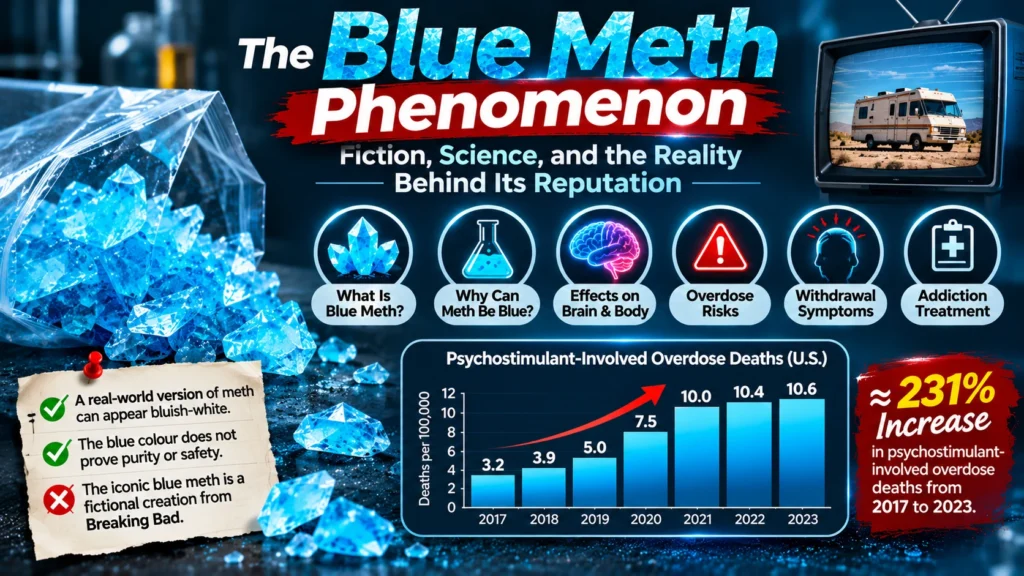
Research Chart: Changes in U.S. Overdose Death Rates Involving Psychostimulants
Public health research provides another perspective on why methamphetamine deserves serious attention. The National Center for Health Statistics (NCHS) published age-adjusted overdose death rates involving psychostimulants with abuse potential in the United States. This category includes methamphetamine, amphetamine, and methylphenidate.
The figures below show the increase between 2017 and 2023. They represent a broader psychostimulant category, not blue meth specifically and not methamphetamine alone.
Graphical Chart: Age-Adjusted Psychostimulant-Involved Overdose Death Rates, 2017–2023
Psychostimulant-Involved Overdose Death Rates
United States | Deaths per 100,000 standard population
3.2
2017
3.9
2018
5.0
2019
7.5
2020
10.0
2021
10.4
2022
10.6
2023
Important limitation: The category includes methamphetamine, amphetamine, and methylphenidate. It does not measure deaths involving blue meth, nor does it isolate methamphetamine-only deaths.
Exact chart placement: Place this chart immediately after the section discussing methamphetamine and public health research. It should appear before the next section, “The Effects of Methamphetamine on Physical and Mental Health.” Keep the research interpretation and source note directly below the chart.
The Effects of Methamphetamine on Physical and Mental Health
Methamphetamine can affect several systems in the body. Its stimulant effects may initially involve increased alertness and activity, but they can also create serious medical complications.
Short-term effects can include increased heart rate, elevated blood pressure, reduced appetite, restlessness, anxiety, and increased body temperature. Severe exposure can result in dangerous cardiovascular and neurological complications.
Long-term exposure can be associated with sleep problems, memory difficulties, emotional changes, dental damage, and psychological distress. Some individuals may also experience paranoia, hallucinations, or other serious mental health symptoms.
The following table summarizes major areas of concern.
| Health area | Possible effects | Public health significance |
|---|---|---|
| Cardiovascular system | Increased heart rate, high blood pressure, irregular heartbeat | Can contribute to heart attack and stroke risk. |
| Brain and nervous system | Changes in attention, mood, memory, and behavior | Can interfere with daily functioning and mental well-being. |
| Mental health | Anxiety, paranoia, hallucinations, sleep disruption | May require professional mental health assessment. |
| Oral health | Dry mouth and severe dental problems | Can lead to significant dental complications. |
| Body temperature | Dangerous overheating | Severe cases can become life-threatening. |
| Overall health | Weight loss, poor sleep, and physical deterioration | Can affect long-term quality of life. |
Why Methamphetamine Addiction Is a Serious Concern
Methamphetamine addiction involves more than repeated substance exposure. It can affect the brain’s reward pathways and influence motivation, decision-making, and emotional regulation.
People experiencing methamphetamine addiction may develop strong cravings and find it difficult to stop despite negative consequences. Work, education, relationships, and financial stability can all be affected.
Dependence and addiction are complex health issues. They can involve biological, psychological, and environmental factors. Blaming an individual or assuming that recovery depends only on willpower can discourage people from seeking assistance.
Recognizing the condition as a health concern encourages more constructive conversations about treatment, prevention, and recovery.
Recognizing Overdose Risks and the Need for Medical Attention
Methamphetamine overdose can involve severe physical and psychological symptoms. High exposure can place dangerous stress on the cardiovascular system and body temperature regulation.
Warning signs may include chest pain, severe agitation, confusion, seizures, dangerously elevated body temperature, irregular heartbeat, or loss of consciousness.
These symptoms require immediate medical attention. An individual experiencing a suspected overdose should not be left alone or expected to recover without professional assistance. Contact local emergency medical services immediately.
Overdose risks can become more complicated when multiple substances are involved. Public health education therefore emphasizes the importance of accurate information, early recognition, and access to emergency care.
Meth Withdrawal Symptoms and the Importance of Recovery Support
Stopping methamphetamine after repeated exposure can involve a range of withdrawal symptoms. The experience differs between individuals and may depend on their overall health and history of substance exposure.
Possible symptoms include fatigue, increased sleep, mood changes, anxiety, difficulty concentrating, and strong cravings. Some individuals may experience depression or significant psychological distress.
Professional assessment can help identify additional mental health concerns and determine appropriate support. Recovery may involve behavioral therapies, structured treatment programmes, regular follow-up, and practical support from family or community services.
Meth addiction treatment is not identical for everyone. A qualified healthcare professional can help develop an appropriate plan based on the individual’s needs. Support should address both substance-related concerns and wider health or social difficulties.
How Accurate Information Can Challenge Online Myths
Searches for blue meth real, is blue meth real, and what does blue crystal meth look like show how entertainment and internet discussions can influence public curiosity. However, online popularity does not make a claim scientifically accurate.
One common misunderstanding is that a distinctive colour proves a particular level of purity. There is no reliable basis for using colour alone to determine purity, strength, or chemical identity.
Another misunderstanding is that a fictional television portrayal accurately represents real-world drug chemistry. Entertainment productions may use visual effects, props, and simplified explanations to support a storyline.
Reliable information should come from established medical and public health sources. The DEA, NIDA, MedlinePlus, and the National Center for Health Statistics provide information that can help readers distinguish documented facts from popular assumptions.
Public Awareness, Prevention, and the Role of Reliable Sources
Public awareness is an important part of reducing substance-related harm. Educational content can help readers understand the difference between fictional portrayals and actual medical risks.
Schools, families, healthcare providers, and community organizations can contribute by discussing substance use without stigma. Clear information about addiction, mental health, overdose recognition, and treatment access can encourage earlier intervention.
Online publishers also have a responsibility to present health information carefully. Articles should distinguish research findings from assumptions, avoid exaggerated claims, and provide links to credible sources.
For topics such as blue meth and crystal methamphetamine, responsible publishing means explaining the cultural background while keeping the scientific and health context accurate.
Final Perspective
The blue meth phenomenon demonstrates how a fictional image can become a widely recognized part of popular culture. However, the scientific reality of methamphetamine is much more serious than its television portrayal suggests. Colour does not establish purity, chemical identity, or safety, and an unfamiliar substance cannot be reliably identified through appearance.
Research from the DEA, NIDA, MedlinePlus, and NCHS provides a clearer understanding of methamphetamine, its health effects, addiction risks, and wider public health impact. Separating fictional storytelling from verified information helps readers make sense of online discussions without confusing entertainment with science.
Ultimately, the most important part of this discussion is awareness. Accurate information, early medical intervention, and access to appropriate addiction treatment can help reduce harm and support healthier communities.
