
Buy Heroin
Powder Heroin and the New Reality of the Opioid Crisis
Nov
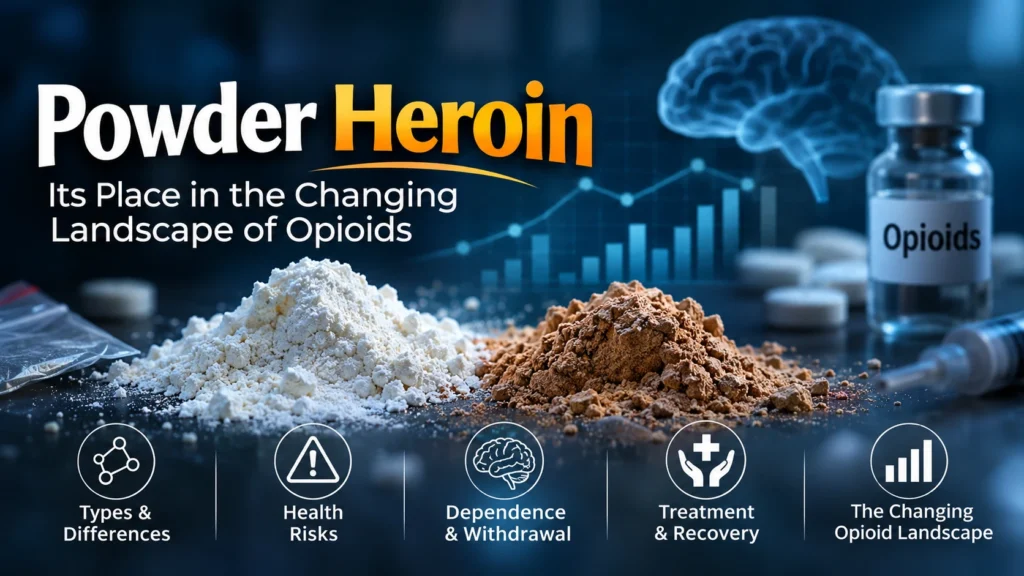
Powder Heroin: Its Place in the Changing Landscape of Opioids
Powder heroin has been part of the wider conversation about opioids for decades. However, the way people understand this substance has changed considerably. Discussions that once focused mainly on heroin now take place within a much more complicated environment involving synthetic opioids, unpredictable illicit drug supplies, public health concerns, and changing patterns of substance-related harm.
The term powder heroin may sound straightforward, but it does not describe a single consistent substance with predictable characteristics. Heroin in powder form can vary in appearance and composition. In addition, the presence of other substances can make an already dangerous situation considerably more difficult to assess. As a result, conversations about powder heroin need to move beyond its name or physical appearance.
Understanding this subject also means looking at the history of opioids, the difference between naturally derived and synthetic substances, and the public health challenges associated with an unpredictable drug supply. These issues help explain why powder heroin remains relevant in discussions about addiction, overdose prevention, and access to treatment.
How Powder Heroin Became Part of the Opioid Conversation
Heroin is an opioid derived from morphine, which originates from the opium poppy. Its history is closely connected to the wider development of opioid medicines and the later emergence of non-medical opioid markets. Over time, heroin became associated with serious health and social consequences, particularly where access to treatment and harm-reduction services was limited.
The term powder heroin generally refers to heroin found in a powdered form. Nevertheless, this description does not establish its chemical composition, purity, or strength. Illicit substances do not follow the consistent manufacturing and quality-control standards expected of regulated medicines. Therefore, two samples described using the same name may have very different compositions.
This distinction matters because public discussions sometimes treat the words used to describe a substance as though they provide reliable information about what it contains. In reality, a street name or physical description cannot confirm the identity of an unknown substance.
Heroin has also become part of a broader discussion about the changing opioid landscape. Synthetic opioids, particularly fentanyl and related substances, have created additional challenges for public health authorities. Consequently, modern conversations about heroin increasingly consider the wider environment in which different opioids may appear together or be incorrectly identified.
Why the Appearance of Powder Heroin Can Be Misleading
One reason powder heroin receives attention is its association with different colours and physical descriptions. Terms such as white powder heroin, brown powder heroin, and heroin powder are commonly used in public discussions. However, these descriptions should not be treated as reliable identification methods.
Illicit heroin can vary in colour, consistency, and composition. Its appearance may be affected by impurities, processing conditions, and other substances present in an unregulated supply. Furthermore, the same general colour description does not guarantee that two samples contain the same substance.
This is why questions such as what does powder heroin look like or what color is heroin powder cannot be answered in a way that reliably identifies an unknown sample. A white powder is not necessarily heroin, and a brown powder is not necessarily heroin either. Many unrelated substances can have similar physical appearances.
Descriptions such as brown powder drug, brown drug powder, and white powder drug are therefore too broad to establish chemical identity. Even experienced observers cannot reliably determine the contents or strength of an unknown substance through appearance alone.
Colour Does Not Establish Chemical Identity
Colour-based descriptions can create a false sense of certainty. Someone may assume that a particular appearance indicates a specific type of heroin, while overlooking the possibility of other substances or unexpected contaminants. This assumption can be dangerous because the risks associated with opioids depend on their actual chemical contents and the circumstances of exposure.
Laboratory testing is necessary to establish what a sample contains. Even then, a test result must be interpreted carefully because the presence of one substance does not necessarily reveal every compound in a mixture. This uncertainty is an important part of the wider public health discussion.
It is also important to distinguish between a general description and a scientific identification. A term such as brown powder heroin may appear in conversations or online searches, but it does not represent a standard chemical classification. The same principle applies to white powder heroin and other colour-based descriptions.
Powder Heroin and the Wider Variety of Opioids
The opioid landscape is not limited to heroin. It includes naturally derived opioids, semi-synthetic opioids, and fully synthetic substances. Although these categories share some pharmacological effects, they are not interchangeable. Their chemical structures, medical uses, and potential risks can differ considerably.
Heroin is derived from morphine, while fentanyl is a synthetic opioid. This difference is important when discussing modern drug-related risks. Fentanyl and related synthetic opioids have become a major concern because they can be present in illicit supplies without being accurately identified by the people exposed to them.
The expression heroin in powder form does not automatically mean that a substance contains heroin alone. Illicit mixtures may contain multiple compounds, and the contents may not match the name used to describe them. Consequently, the wider opioid conversation increasingly focuses on uncertainty rather than relying on traditional street terminology.
Heroin and Synthetic Opioids Are Not the Same
Heroin and fentanyl belong to the broader opioid category, but they are chemically different substances. Their shared classification does not make them equivalent. In particular, fentanyl is a synthetic opioid, whereas heroin is produced from morphine.
This distinction is especially relevant when discussing overdose risks. Synthetic opioids can contribute to severe respiratory depression, and unexpected exposure can make an already dangerous situation more difficult to recognise. A substance described as heroin may also contain other opioids, making assumptions based on its name unreliable.
| Comparison area | Heroin | Fentanyl |
|---|---|---|
| General classification | Opioid | Synthetic opioid |
| Origin | Derived from morphine | Manufactured synthetically |
| Relationship to the opioid category | Derived from an opium alkaloid | Belongs to the synthetic opioid group |
| Appearance as an identification method | Appearance cannot confirm identity or composition | Appearance cannot confirm identity or composition |
| Major health concern | Dependence, respiratory depression, and overdose | Severe respiratory depression and overdose |
| Public health context | Long-standing concern in illicit opioid markets | Major concern in the changing synthetic opioid landscape |
The comparison shows why the names of substances should not be used as substitutes for chemical identification. Both substances can cause serious harm, but their different origins and characteristics matter when interpreting public health information.
The Changing Public Health Picture Behind Opioid Use
Public health discussions about opioids have changed as the composition of illicit drug supplies has become more unpredictable. Heroin remains an important part of this history, but synthetic opioids have increasingly shaped the conversation in several regions.
One useful way to understand this change is to examine overdose statistics. Data from the United States show that deaths involving different opioid categories have not followed identical patterns. Although the rates involving heroin and synthetic opioids both declined between 2023 and 2024, synthetic opioids continued to account for a substantially higher age-adjusted overdose death rate.
This does not mean that heroin-related harm has disappeared. Instead, it demonstrates that the wider opioid crisis cannot be understood by looking at heroin alone. Public health planning needs to consider multiple substances, changing patterns of exposure, and the availability of effective treatment.
What Recent Overdose Statistics Tell Us
The following figures provide a comparison of age-adjusted overdose death rates involving selected opioid categories in the United States. The rates are measured per 100,000 people and compare 2023 with 2024. They show the difference between heroin-related deaths and deaths involving synthetic opioids other than methadone.
Opioid-Involved Overdose Death Rates: 2023 vs. 2024
United States | Age-adjusted rates per 100,000 population
| Opioid category | 2023 rate | 2024 rate | 2023 visual | 2024 visual |
|---|---|---|---|---|
| Synthetic opioids | 22.2 | 14.3 | ██████████████████████ | ██████████████ |
| Heroin | 1.2 | 0.8 | █ | ▊ |
| Natural / semi-synthetic opioids | 2.9 | 2.3 | ███ | ██ |
| Methadone | 1.0 | 0.9 | █ | █ |
Chart scale: Each full block represents approximately one death per 100,000 people. Values are rounded for visual presentation; the numerical rates are the primary data.
Interpretation: The synthetic-opioid rate was substantially higher than the heroin rate in both years. Both rates declined in 2024. These figures describe deaths involving opioid categories; they do not measure the purity, appearance, or prevalence of powder heroin.
Why Unpredictable Drug Supplies Increase the Risk
One of the most serious concerns associated with illicit opioid supplies is uncertainty. A substance may be sold or described using one name, yet its actual composition may be different. It may also contain multiple substances, including compounds that create additional health risks.
This problem makes it difficult to assess exposure based on appearance, terminology, or assumptions about a particular drug category. The same concern applies to substances described as heroin powder, brown powder heroin, or white powder heroin. These expressions do not provide dependable information about chemical contents.
Unpredictability can also complicate emergency responses. Medical professionals may not initially know which substances are involved, particularly when someone is unable to communicate. This is one reason why suspected opioid overdose requires urgent medical attention rather than attempts to identify a substance through visual inspection.
The Importance of Accurate Information
Accurate information can help reduce misunderstandings surrounding opioids. For example, treating all white powders as one substance or assuming that a brown powder must be heroin creates an unreliable picture of the risks involved.
Clear public health communication should explain that physical appearance cannot establish identity. It should also distinguish between naturally derived and synthetic opioids, while recognising that illicit markets can involve unexpected mixtures.
These distinctions are important for families, healthcare professionals, educators, and communities. Better information supports more informed conversations and reduces the likelihood that dangerous assumptions will be treated as facts.
Uncertainty also highlights the importance of accessible testing services and timely medical support. Where available, professional drug-checking services can help identify some substances in a sample. However, testing methods have limitations, and no result should be treated as a guarantee that a substance is safe.
How Opioids Affect the Body and Why Overdose Is Serious
Opioids affect receptors in the nervous system and can influence pain perception, alertness, and breathing. Although these effects are relevant to some medical uses, exposure outside a controlled medical setting can create serious risks.
One of the most dangerous effects is respiratory depression. This occurs when breathing becomes dangerously slow or shallow. In severe cases, breathing may stop, preventing the body from receiving the oxygen it needs. This can result in permanent injury or death.
Opioid-related overdose can also involve extreme drowsiness, loss of consciousness, and an inability to respond normally. The risk can become more complicated when multiple substances are involved, especially substances that also suppress the central nervous system.
Recognising a Possible Opioid Overdose
Warning signs can include unconsciousness, difficulty waking someone, slow or shallow breathing, unusual snoring or gurgling sounds, and very small pupils. The skin may also become cold or clammy. However, not every person will show every sign.
When an opioid overdose is suspected, emergency medical services should be contacted immediately. Naloxone may temporarily reverse an opioid overdose when it is available and used according to its instructions. However, its effects can wear off, and symptoms may return. Therefore, emergency medical assessment remains essential even when a person appears to recover.
Understanding these warning signs is not simply a matter of recognising one particular substance. The same emergency response principles are relevant across different opioid-related situations.
Dependence, Recovery, and the Need for Long-Term Support
Opioid dependence is a complex health condition that can affect physical health, emotional wellbeing, family relationships, and everyday responsibilities. It should not be reduced to a question of personal character or willpower. Instead, it requires an understanding of the biological, psychological, and social factors that influence substance use.
People experiencing opioid dependence may find it difficult to stop without professional support. Withdrawal can involve anxiety, restlessness, sweating, sleep difficulties, muscle aches, abdominal cramps, nausea, vomiting, and diarrhoea. The intensity and duration of symptoms can vary between individuals.
These challenges can make access to appropriate treatment especially important. A healthcare professional can assess an individual’s circumstances and discuss suitable treatment options. Depending on the situation, care may include medication-assisted treatment, counselling, psychological support, and continuing recovery services.
Why Treatment Should Be Individualised
There is no single recovery pathway that is suitable for everyone. Treatment decisions depend on a person’s health, history of opioid exposure, other medical needs, and available support. A professional assessment helps determine which options are appropriate.
Medications such as buprenorphine and methadone may be used as part of treatment under medical supervision. They can help manage opioid dependence and support a more stable recovery process. Counselling and ongoing support can also address emotional challenges, personal circumstances, and the factors that contribute to substance use.
Recovery is not always a straight line. Some individuals experience setbacks, while others require changes to their treatment plan over time. Continued access to healthcare and non-judgmental support can make a meaningful difference.
Support from family members and trusted people can also be valuable. However, it is important to approach these conversations without blame or stigma. Practical assistance, encouragement to seek professional care, and respect for personal circumstances can help create a more supportive environment.
Why Language Matters When Discussing Powder Heroin
The words used in public discussions can influence how people understand substance-related risks. Search terms such as what drug is a brown powder, what drug is a white powder, and does heroin come in powder form reflect common questions. However, these questions can also reveal how easily appearance and identity become confused.
A responsible discussion should answer the underlying concern without suggesting that a visual description can identify an unknown substance. It should also avoid presenting street terminology as though it were a standard scientific classification.
Language matters in another way as well. People affected by substance dependence may face stigma, isolation, or fear of seeking help. Using respectful and factual language can encourage more open conversations about health and treatment.
For publishers and health communicators, this means providing context rather than relying on sensational descriptions. A balanced article should explain the historical role of heroin, the changing opioid environment, and the importance of professional support without turning a serious public health subject into promotional or instructional content.
The Wider Opioid Landscape Is Still Evolving
The conversation surrounding powder heroin is part of a much larger change in how opioid-related risks are understood. Traditional heroin markets, synthetic opioids, changing supply patterns, and public health responses are connected issues. However, they should not be treated as identical problems.
Recent US statistics show that overdose death rates involving heroin declined between 2023 and 2024. Rates involving synthetic opioids also declined, although they remained considerably higher. These figures provide an important snapshot, but they do not describe every country or every local drug market.
Global patterns can differ because of variations in drug supply, healthcare access, treatment availability, and public policy. Therefore, statistics from one country should not automatically be used to describe conditions elsewhere.
What remains consistent is the importance of reliable information. Physical appearance cannot confirm the identity of an unknown powder, and a familiar substance name cannot guarantee predictable contents. Public health responses must account for these uncertainties while improving access to emergency care, treatment, and long-term recovery support.
A More Informed Conversation About Opioids
Powder heroin remains a relevant subject because it connects the history of heroin with the wider challenges of today’s opioid environment. Its significance is not limited to the substance’s physical form. It also involves changing illicit supplies, the risks of unexpected exposure, and the wider effects of opioid dependence on individuals and communities.
A more informed conversation starts by recognising the limits of appearance-based identification, understanding the differences between opioid categories, and taking overdose risks seriously. Most importantly, it recognises that prevention, medical care, and ongoing recovery support are essential parts of addressing opioid-related harm.
