
Buy Heroin
Brown Powder Heroin: Why Drug Monitoring Is Facing a New Challenge
Nov
Brown Powder Heroin in a Changing Drug Landscape: New Research, Composition Concerns and Public Health Trends
The discussion surrounding brown powder heroin is changing as researchers, public health organisations and drug-monitoring agencies examine a more complex opioid landscape. Traditionally, public information about heroin has focused on its background, general characteristics and health effects. However, newer research raises wider questions about the composition of illicit substances, the appearance of emerging synthetic opioids and the challenges these developments create for public health services.
Brown powder heroin remains an important subject in European drug research. Yet it cannot be considered separately from wider developments involving unknown substances, inconsistent composition and the growing presence of synthetic opioids. These developments make reliable information increasingly important.
One particularly important distinction is that the appearance of a substance does not establish its chemical identity. A brown powder, white powder or yellowish substance cannot be reliably identified through colour or texture alone. Research and laboratory analysis are necessary to understand composition.
This article examines the changing research conversation around brown powder heroin, focusing on emerging opioid concerns, drug-monitoring findings, composition uncertainty and the wider implications for healthcare and public health.
A Changing Opioid Landscape: Why Composition Matters
The European opioid landscape is no longer defined by one substance or one consistent pattern. Established drugs continue to contribute to health-related problems, while newer synthetic compounds introduce additional challenges.
The European Union Drugs Agency (EUDA) has highlighted the increasing diversity of substances appearing in European drug markets. Its research discusses established opioids alongside newer synthetic opioids, including nitazenes and other emerging compounds.
This development matters because different substances can have different pharmacological properties and levels of toxicity. In particular, highly potent synthetic opioids can create serious poisoning risks, especially when their presence is not known.
For discussions about brown powder heroin, this creates an important research question: how can public health organisations understand the composition of substances when their contents may vary and monitoring systems may not detect every emerging compound?
The answer involves continued surveillance, laboratory analysis, toxicological research and cooperation between public health organisations.
What Recent Research Reveals About Emerging Opioids
The EUDA’s European Drug Report 2026 highlights developments involving new synthetic opioids in Europe. Its findings show that the opioid landscape is evolving, with new substances being identified and additional concerns emerging around potentially dangerous compounds.
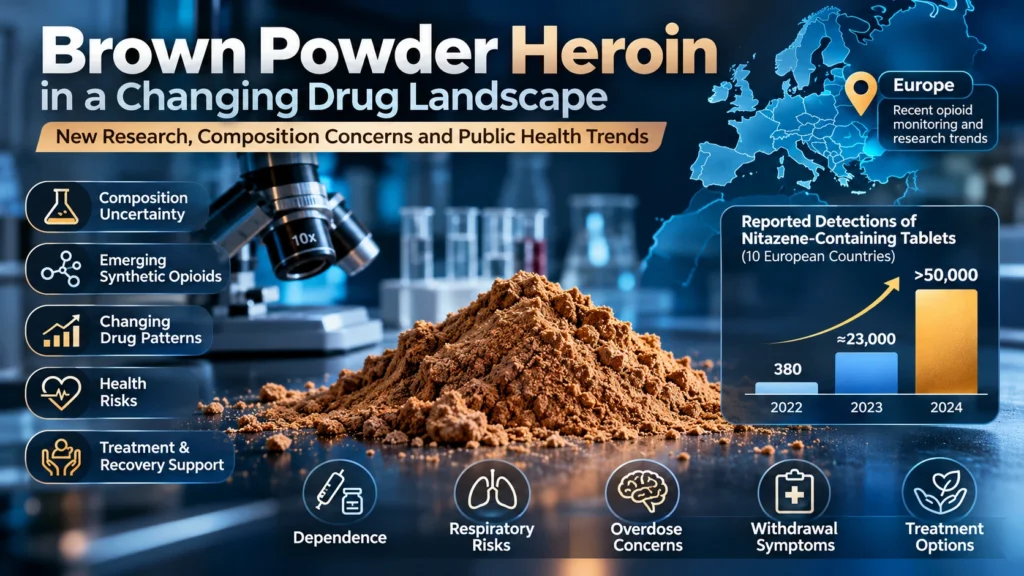
One notable finding concerns nitazene-containing tablets. The report states that 10 European countries detected more than 50,000 such tablets in 2024, compared with approximately 23,000 in 2023 and 380 in 2022.
These figures demonstrate an important change in the monitoring picture. They do not measure heroin powder or prove that nitazenes are present in brown powder heroin. Instead, they illustrate a wider development in the European synthetic-opioid environment.
The report also identifies additional emerging synthetic opioid families, including orphines. These findings reinforce the importance of monitoring substances beyond traditional drug categories.
For public health researchers, the broader concern is the possibility that unfamiliar compounds may create unexpected medical emergencies and complicate existing approaches to overdose prevention.
Research Chart: Reported Nitazene-Containing Tablet Detections
The following figures illustrate reported detections of nitazene-containing tablets across 10 European countries. They provide context about the wider synthetic-opioid environment rather than measuring brown powder heroin samples.
| Year | Reported detections | Visual comparison |
|---|---|---|
| 2022 | 380 | ■ |
| 2023 | Approximately 23,000 | ■■■■■■■■■■ |
| 2024 | More than 50,000 | ■■■■■■■■■■■■■■■■■■■■ |
Brown Powder Heroin and the Problem of Composition Uncertainty
Brown powder heroin is discussed in several European drug-information resources. Drug Science describes brown heroin as an off-white to brown powder or a collection of powdery clumps. However, appearance alone cannot establish the exact composition of an unknown substance.
This distinction is important because illicit substances are not produced under the same pharmaceutical quality-control standards as approved medicines.
The composition of an illicit sample may vary. It may contain substances other than the expected drug, and some contaminants can introduce additional health concerns.
The European Drug Report 2025 also reported considerable variation in the average retail purity of brown heroin across reporting countries. Its data showed a range from 5% to 40% in 2023, with half of the countries reporting average purity between 13% and 21%.
These figures should be interpreted carefully. They describe reported country-level averages, not the composition of every sample or a prediction of what an individual substance contains.
The wider research lesson is that assumptions based on appearance, name or general descriptions are unreliable. Chemical analysis and appropriate public health monitoring remain essential.
Research Comparison: What Different Sources Highlight
Different research organisations examine heroin and opioid-related concerns from different perspectives. Some focus on scientific research, while others concentrate on medical information, drug monitoring or community support.
The following comparison summarises the main contributions of the organisations referenced in this article.
| Research source | Main area of focus | What it contributes |
|---|---|---|
| European Union Drugs Agency | European drug-market monitoring | Tracks heroin, other opioids, emerging substances and related health concerns. |
| Drug Science | Scientific information about heroin | Explains brown heroin in the context of its broader scientific and health profile. |
| Drug Enforcement Administration | Drug information and public safety | Highlights the unpredictable nature and serious risks associated with heroin. |
| MedlinePlus | Medical information | Covers opioid effects, overdose concerns and treatment information. |
| We Are With You | Public health and support | Discusses overdose warning signs, withdrawal and access to support. |
| Bristol Drugs Project | Community health information | Focuses on health risks, emergency awareness and support services. |
These sources should not be treated as interchangeable. A scientific research organisation, a government drug-monitoring agency and a medical information service have different responsibilities and use different forms of evidence.
Together, however, they help explain why brown powder heroin remains relevant to wider discussions about opioid-related health risks.
Why Visual Identification Is an Unreliable Approach
Online searches for phrases such as brown powder drug, white powder drug, yellowish powder drug and heroin powder often reflect an interest in identifying unfamiliar substances.
However, visual descriptions have important limitations.
Colour can vary because of different materials, impurities and other factors. Two substances with similar appearances may have entirely different chemical compositions. Likewise, substances with different appearances may contain related compounds.
This is why visual identification should not be treated as a reliable medical or scientific method.
The DEA and other public health organisations emphasise the risks associated with unknown drug composition. The important point is not whether a substance looks like a particular drug, but whether its contents have been scientifically established.
This issue also affects online information. Articles that present colour descriptions as definitive identification methods can create misleading impressions and potentially increase health risks.
A more responsible approach is to explain the limitations of appearance-based identification and direct readers towards qualified healthcare professionals and appropriate laboratory services.
The Wider Role of Synthetic Opioids in Public Health Research
Synthetic opioids have become an increasingly important part of European drug-monitoring discussions.
The EUDA’s 2025 and 2026 reporting describes the emergence of nitazenes and other synthetic opioid groups. These developments are significant because some compounds can be highly potent and may be associated with severe poisoning.
The 2025 report also discussed concerns about nitazenes appearing in substances mis-sold as other drugs. This highlights a broader challenge: the identity of a substance may not match the description under which it is encountered.
For researchers studying brown powder heroin, this is relevant as part of the wider opioid environment. It does not establish that all heroin samples contain synthetic opioids, nor does it mean that every reported synthetic-opioid detection involves heroin.
Keeping these distinctions clear is essential for accurate reporting.
The growing diversity of opioid-related substances also creates challenges for toxicology laboratories, emergency departments and public health monitoring systems. Testing procedures need to remain responsive to emerging compounds so that medical professionals can better understand unexpected poisoning cases.
How Drug-Monitoring Systems Help Identify Changing Patterns
Modern drug monitoring involves more than counting seizures. Public health agencies use several types of information to understand developments and identify emerging concerns.
These can include:
- Laboratory analysis of collected samples.
- Toxicology findings from medical cases.
- Reports of non-fatal and fatal poisonings.
- Drug-treatment service information.
- Seizure data from law enforcement agencies.
- Early-warning reports about newly identified substances.
Each type of information has limitations. Seizure data, for example, cannot independently establish how common a substance is among the general population. Similarly, treatment-entry statistics represent people accessing particular services rather than every person experiencing opioid-related problems.
A combination of monitoring methods provides a more complete picture.
This is particularly important when studying changes in brown powder heroin and the broader opioid environment. Researchers need to distinguish between established evidence, emerging signals and findings that require further investigation.
The Public Health Consequences of Unpredictable Composition
Unpredictable composition can create serious health concerns because the effects of an unknown substance cannot be reliably anticipated.
Heroin is associated with respiratory depression, dependence and potentially fatal overdose. The presence of other substances may introduce additional complications.
MedlinePlus identifies respiratory problems, infections and organ-related complications among the health concerns associated with heroin use.
The risks can also extend beyond immediate physical effects. Long-term opioid dependence may affect mental health, relationships, employment and the ability to manage everyday responsibilities.
For healthcare services, unpredictable composition creates another challenge. Medical professionals may need to assess symptoms without knowing exactly which substances were involved.
This is why toxicological testing, accurate medical histories and appropriate emergency responses are important components of public health care.
Why Opioid Research Needs More Than Traditional Drug Categories
Traditional drug classifications remain useful, but they do not always capture the complexity of changing substance markets.
A discussion focused only on heroin powder may overlook developments involving synthetic opioids, counterfeit medicines and mixed-substance exposure.
Similarly, an article that concentrates only on emerging synthetic substances may overlook the continuing health burden associated with established opioids.
The EUDA’s reporting demonstrates the importance of examining these issues together while keeping their individual evidence separate.
This broader approach is more useful than treating every new development as proof of a direct change in brown powder heroin itself.
Research needs to consider several questions:
- Are new opioid compounds being identified?
- Are monitoring systems detecting unexpected substances?
- Are poisoning patterns changing?
- Are healthcare services prepared to respond?
- Are treatment and support services accessible?
- Are public information resources communicating uncertainty accurately?
These questions provide a stronger foundation for understanding the changing opioid landscape.
Treatment, Recovery and the Importance of Healthcare Access
Although research into drug composition and emerging substances is important, the human impact of opioid dependence must remain central to the discussion.
Heroin dependence is a medical issue that can be treated with appropriate support. Treatment may involve medication, behavioural interventions, counselling and continuing healthcare.
MedlinePlus identifies medication-based treatment and behavioural support as important elements of care for opioid use disorder.
Medication-Based Treatment
Medicines such as methadone and buprenorphine are used by healthcare professionals in the treatment of opioid dependence. These medications can help manage withdrawal and support ongoing treatment.
Treatment decisions should be made with qualified medical professionals who can assess individual circumstances and recommend an appropriate care plan.
Behavioural and Psychological Support
Behavioural treatment can help individuals understand patterns associated with substance dependence and develop strategies for recovery.
Support may include:
- Individual counselling.
- Cognitive behavioural therapy.
- Family support.
- Mental health services.
- Recovery programmes.
- Follow-up appointments.
A combination of medical and behavioural support may be appropriate for many people.
Why Ongoing Support Matters
Recovery is not always a straightforward process. Some people experience setbacks or require changes to their treatment plan. Continued access to healthcare and supportive relationships can help individuals remain engaged with recovery services.
People concerned about their own opioid use or someone else’s can contact a local addiction treatment service or healthcare professional for confidential guidance.
What the Emerging Research Means for Future Public Health Discussions
The available evidence suggests that opioid-related research needs to become more responsive to changes in substance composition and the appearance of new compounds.
The EUDA’s reporting on synthetic opioids demonstrates why ongoing monitoring is important. At the same time, research on brown powder heroin continues to highlight concerns around variation in composition and the limitations of visual identification.
However, it is important not to overstate the findings. A rise in detections of nitazene-containing tablets does not automatically mean that brown powder heroin has changed in the same way. Different datasets measure different substances and different aspects of the drug environment.
Future research will need to connect laboratory findings, toxicology reports, treatment data and public health monitoring while maintaining clear distinctions between established findings and emerging concerns.
This approach can help researchers, medical professionals and public health organisations respond more effectively to changing opioid-related risks.
Frequently Asked Questions
Why Is Brown Powder Heroin Still Discussed in European Drug Research?
It remains relevant because heroin continues to contribute to opioid-related health problems in Europe. Research also examines its composition, purity variation and relationship to wider changes in the opioid environment.
Does the Appearance of Brown Powder Heroin Confirm Its Composition?
No. Colour and texture cannot reliably establish chemical identity, purity or strength. Laboratory analysis is required for scientific identification.
Are Nitazenes the Same as Heroin?
No. Nitazenes are a group of synthetic opioids. They are chemically distinct from heroin, although both are relevant to wider research into opioid-related health risks.
What Does Recent European Research Say About Synthetic Opioids?
The EUDA has reported the detection of additional synthetic opioid compounds and growing concerns about potentially dangerous substances. Its 2026 report also highlights substantial increases in reported detections of nitazene-containing tablets between 2022 and 2024.
Why Is Drug Composition Important for Public Health?
Composition affects the potential health risks associated with exposure. Unknown substances can complicate medical assessment and increase uncertainty around poisoning cases.
How Can People Access Support for Opioid Dependence?
People concerned about opioid dependence can contact a qualified healthcare professional, addiction treatment service or recognised support organisation. Treatment may include medical care, medication-based support and counselling.
Conclusion: Understanding a Changing Opioid Landscape
Brown powder heroin remains an important subject in opioid research, but the wider conversation is becoming more complex. New synthetic opioids, unpredictable substance composition and developments in drug-monitoring systems are changing how public health organisations examine opioid-related risks.
Recent European research demonstrates the importance of monitoring emerging compounds while maintaining a clear distinction between different substances and datasets.
The most useful discussions are those that combine reliable research, accurate scientific explanations and responsible public health information. Understanding these developments can help readers move beyond outdated assumptions and recognise why continued research, medical support and effective monitoring remain essential.
