
Uncategorized
Amphetamine: Science, History, Effects and Social Impact
Nov
Amphetamine in Modern Society: Science, History and Its Wider Impact
Amphetamine has a complex place in modern medicine, neuroscience and public-health discussions. Scientists have studied its effects on the central nervous system for more than a century, while medical professionals have used certain amphetamine-based medicines to address specific health conditions. At the same time, non-medical use has raised important questions about dependence, cardiovascular health, psychological wellbeing and drug regulation.
The subject also has a long cultural and historical background. Terms such as Amfetamin, Amphetamines, Speed and Benzedrine appear in medical publications, historical accounts and public-health discussions. Although these names are often associated with stimulant substances, they do not all describe exactly the same thing.
Understanding amphetamine requires more than looking at its stimulant properties. Its history illustrates how scientific discoveries can influence medical practice, how public understanding changes as evidence develops, and why responsible pharmaceutical regulation remains important.
The Science Behind Amphetamine
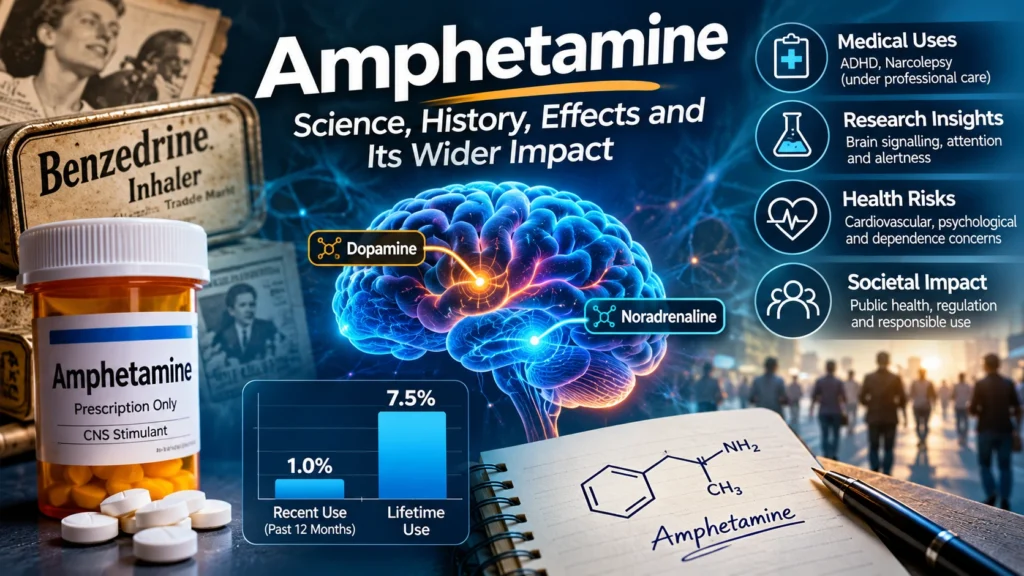
Amphetamine is a stimulant that acts on the central nervous system. This system includes the brain and spinal cord, which coordinate many of the body’s physical and mental functions. Amphetamine affects chemical communication between nerve cells, particularly pathways involving dopamine and noradrenaline.
These neurotransmitters contribute to several important processes. Dopamine plays a role in motivation, reward, attention and movement. Noradrenaline contributes to alertness, concentration and the body’s response to stress. Changes in these systems help explain why stimulant substances can influence both mental activity and physical responses.
However, the effects of amphetamine depend on the particular substance and the circumstances involved. A pharmaceutical medicine used under professional supervision is not equivalent to an unregulated substance. Differences in composition, quality and medical oversight can significantly affect the risks involved.
Why Dopamine and Noradrenaline Matter
Dopamine is often discussed in connection with the brain’s reward system. However, its functions extend beyond pleasure. It also contributes to learning, motivation, movement and the ability to respond to important experiences.
Noradrenaline has a different but related role. It helps regulate attention, alertness and physiological responses to stressful situations. Researchers study these neurotransmitter systems to understand stimulant activity and its relationship with different neurological and behavioural processes.
These biological mechanisms are also relevant to medical research. They help explain why some stimulant medicines have a place in carefully selected clinical treatments, while also highlighting why unsupervised exposure can create health concerns.
Amphetamine and Its Place in Medical Research
Amphetamine-related medicines have been studied in connection with several medical conditions. Certain prescription stimulants have recognised clinical applications, particularly in the treatment of attention-deficit/hyperactivity disorder (ADHD) and narcolepsy.
ADHD can affect attention, impulse control and activity levels. Narcolepsy is a neurological sleep disorder that can cause excessive daytime sleepiness and other sleep-related symptoms. In selected cases, healthcare professionals may prescribe stimulant medicines as part of a broader treatment plan.
Medical treatment involves more than identifying a substance. Clinicians consider the patient’s symptoms, medical history, other medicines and possible adverse effects. They also assess whether a particular medicine is appropriate for the individual’s circumstances.
This distinction is important because the existence of a medical application does not establish that every amphetamine-related substance is safe or suitable for general use. Pharmaceutical approval, product quality and professional supervision remain separate considerations.
Prescription Medicines and Non-Medical Substances
Prescription amphetamine medicines have defined pharmaceutical ingredients and product information. Their clinical use is subject to medical and regulatory requirements. Non-medical substances, on the other hand, may have uncertain composition and can involve additional risks.
Public-health organisations therefore distinguish between prescribed stimulant treatment and the use of unregulated substances. This distinction helps readers understand why the same broad chemical category can appear in both medical literature and discussions about substance-related harm.
From Benzedrine to Modern Pharmaceutical Regulation
The history of amphetamine is closely connected with the development of modern pharmaceutical research. Scientists first synthesised amphetamine in the late nineteenth century, but its wider medical and commercial use developed during the twentieth century.
One important historical name was Benzedrine. Introduced during the 1930s, Benzedrine became associated with early amphetamine-containing products, including inhalers marketed for nasal congestion. Historical accounts describe how interest in the substance expanded as researchers investigated its stimulant properties.
During the following decades, amphetamine-containing medicines became part of wider medical discussions. Their use expanded into areas such as sleep disorders and other conditions. However, growing use also raised concerns about dependence, inappropriate prescribing and potential long-term harm.
Benzedrine and the Changing Medical Landscape
The history of Benzedrine is more than a story about an early pharmaceutical product. It illustrates how medical understanding can change when new evidence becomes available.
The Smithsonian’s historical account, A Speedy History of America’s Addiction to Amphetamine, describes how amphetamine products became widely used in the United States and how public awareness of their risks developed over time. The article also discusses the influence of pharmaceutical marketing, medical prescribing and changing social attitudes.
As concerns about misuse and dependence increased, governments introduced tighter controls. In the United States, amphetamine became a Schedule II controlled substance under federal law. Other countries developed their own regulatory frameworks to control medical access and reduce non-medical use.
These historical developments remain relevant today. They demonstrate why pharmaceutical decisions need evidence, appropriate oversight and continued monitoring rather than relying only on early expectations about a medicine’s benefits.
Understanding the Different Names Used for Amphetamine
Online searches and public-health publications use several names when discussing amphetamine-related substances. Some terms describe the chemical itself, while others represent language variations, historical product names or informal expressions.
For example, Amfetamin is a spelling used in several European languages. Searches such as Co je amfetamin and Amfetamin co to je are commonly phrased as questions about the substance’s meaning. These expressions generally reflect an interest in its identity, effects and wider context.
The term Fetamin may also appear in search queries. However, readers should interpret this spelling carefully rather than automatically treating it as a separate chemical substance. Accurate chemical naming is important when comparing scientific or pharmaceutical information.
Speed, Benzedrine and Other Related Expressions
The words Speed droga and Speed drug appear in public-health discussions and informal language. Speed is a street name associated with amphetamine-type stimulant substances, but informal names do not reliably identify a product’s exact chemical composition.
Another expression, Speed drug name, may appear when people try to understand the terminology used in different countries or communities. Such language should be interpreted in context because street names can vary between locations and may refer to different substances.
Benzadrine and Benzedrin are also spellings that may appear in searches related to the historical name Benzedrine. For accurate scientific writing, it is better to distinguish the recognised historical brand name from the chemical name amphetamine.
| Term | Meaning | Context |
|---|---|---|
| Amphetamine | A recognised chemical name | Scientific and medical discussions |
| Amphetamines | Plural term for amphetamine and related stimulant substances | Public-health and pharmacological writing |
| Amfetamin | Alternative language spelling | European-language searches |
| Speed | Informal street name associated with stimulant substances | Public-health and social discussions |
| Benzedrine | Historical brand name associated with amphetamine products | Pharmaceutical history |
| Benzadrine / Benzedrin | Search spelling variations associated with Benzedrine | Historical and terminology searches |
This comparison highlights why terminology matters. A chemical name, a historical brand and an informal street expression serve different purposes. Treating them as interchangeable can create confusion in medical, scientific and public-health discussions.
What Public-Health Research Reveals About Amphetamine Use
Research into stimulant use helps public-health organisations understand patterns of exposure and the wider impact on communities. Population surveys provide useful context because they distinguish between people who have ever used a substance and those who report recent use.
The Australian Institute of Health and Welfare (AIHW) reported findings from the 2022–2023 National Drug Strategy Household Survey. Among Australians aged 14 and over, 1.0% reported using methamphetamine and amphetamine during the previous 12 months, while 7.5% reported lifetime use.
These figures measure different things. Recent use refers to the previous year, whereas lifetime use includes people who may have used the substances at any point in their lives. The figures should therefore not be interpreted as a direct comparison of current and past-year behaviour.
Research-Based Chart: Recent Use Compared With Lifetime Use
The following chart presents the AIHW survey figures for methamphetamine and amphetamine use among Australians aged 14 and over. It illustrates the difference between reported use during the previous 12 months and reported use at any point in life.
Reported methamphetamine and amphetamine use in Australia, 2022–2023
Recent use — previous 12 months: 1.0%
Lifetime use: 7.5%
Source: Australian Institute of Health and Welfare, National Drug Strategy Household Survey 2022–2023. Recent use means use in the previous 12 months.
The survey also reported that around 200,000 Australians aged 14 and over had used methamphetamine and amphetamine in the previous 12 months. Approximately 1.6 million people reported lifetime use. These findings help researchers understand the difference between recent exposure and broader historical experience within a population.
It is important to recognise that these statistics describe Australia, not the entire global population. They also refer to the survey’s defined category of methamphetamine and amphetamine, so they should not be used as a universal estimate for every stimulant or pharmaceutical product.
The Wider Health Effects of Stimulant Exposure
Stimulant substances can influence several systems in the body. Their effects may involve alertness, mood, sleep, appetite and cardiovascular activity. The nature and severity of these effects can differ according to the substance and the individual’s circumstances.
Short-term effects associated with stimulant exposure may include restlessness, increased heart rate, raised blood pressure, reduced appetite, sweating, anxiety and difficulty sleeping. Some people may also experience irritability or changes in behaviour.
More serious complications can occur in cases of toxicity. These may include severe agitation, confusion, seizures, cardiovascular emergencies and other potentially life-threatening conditions. Suspected overdose requires immediate professional medical attention.
Long-Term Physical and Psychological Concerns
Repeated non-medical stimulant use can contribute to a range of health problems. These may include sleep disruption, nutritional difficulties, cardiovascular strain and changes in mental wellbeing.
Psychological concerns can involve anxiety, mood changes, suspicious thoughts and, in some cases, stimulant-related psychosis. The likelihood and severity of these outcomes vary. A healthcare professional can assess symptoms and consider other possible causes rather than assuming that every symptom has the same explanation.
Public-health organisations also highlight the importance of recognising dependence. Repeated use may lead to tolerance, cravings and difficulty controlling substance use. These problems can affect relationships, employment, education and everyday responsibilities.
Why Dependence and Recovery Need a Broader Perspective
Substance dependence is not simply a matter of willpower. It can involve changes in behaviour, psychological wellbeing and the way a person responds to their environment. People experiencing problems with stimulant use may need medical assessment, counselling or structured treatment support.
Withdrawal experiences can include fatigue, changes in sleep, low mood, irritability, increased appetite and cravings. The experience varies between individuals and may be influenced by health history and patterns of substance use.
Professional support can help people understand their symptoms and identify suitable care. Treatment may involve psychological therapies, counselling, ongoing clinical assessment and support from appropriate community services.
Recovery can also involve rebuilding everyday routines and addressing factors that contribute to substance-related problems. Family support and trusted social connections may play a helpful role when the individual wishes to involve them.
Why Accurate Information and Regulation Matter
Amphetamine illustrates the importance of separating scientific information from informal claims. A chemical description does not establish that a particular product is approved for medical use. Similarly, a historical brand name does not confirm the composition or regulatory status of a modern product.
National laws differ, but many countries regulate the manufacture, possession, prescribing and distribution of amphetamine-related substances. These controls aim to support legitimate medical use while reducing risks associated with misuse and unregulated supply.
Readers should rely on recognised medical publications, public-health authorities and official regulatory information when evaluating claims about stimulant substances. This is particularly important when online material uses informal terms such as Speed or presents historical pharmaceutical names without explaining their context.
A More Informed Understanding of Amphetamine
Amphetamine is an important subject in neuroscience, pharmaceutical history and public-health research. Its story includes scientific discovery, medical applications, changing prescribing practices and growing awareness of substance-related risks.
Understanding the differences between Amphetamine, Amfetamin, Amphetamines, Speed and Benzedrine makes it easier to interpret scientific and historical information accurately. It also highlights the importance of distinguishing supervised medical treatment from non-medical use.
Ultimately, a balanced understanding requires attention to both the scientific evidence and the wider social context. Reliable information, appropriate medical oversight and access to professional support remain essential when discussing stimulant substances and their effects.
