
Sep
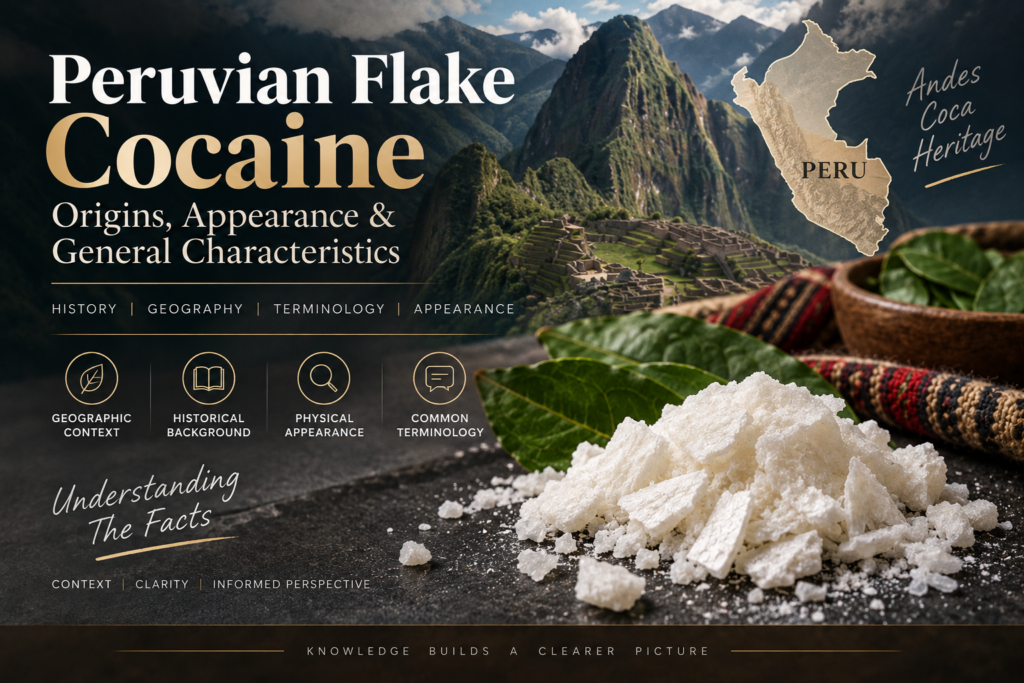
Peruvian Flake Cocaine: Origins, Appearance & General Characteristics
An informational overview of the terminology, geographic association, historical context, and descriptive characteristics of the term.
Peruvian Flake Cocaine is a descriptive term associated with cocaine in illicit drug-market terminology. The phrase combines a geographic reference with a description that has been used in informal language. Understanding the term requires separating historical and geographic associations from assumptions about the identity or quality of an unknown substance.
Understanding Peruvian Flake Cocaine
The expression “Peruvian Flake” is not a formal scientific classification. Instead, it belongs to a wider vocabulary used to describe cocaine in informal and illicit-market contexts.
The term can therefore carry different meanings depending on the source. Geographic references may describe an alleged origin, while “flake” can refer to a visual or textural description used in informal terminology.
Geographic and Historical Context
Peru has a long documented association with coca cultivation and the broader history of cocaine production in South America. Because of this history, geographic labels have become part of the terminology surrounding cocaine markets.
However, a geographic name attached to an illicit-market product does not independently verify where a particular sample was produced.
Origin of the “Peruvian Flake” Term
The term combines two descriptive ideas. “Peruvian” refers to the geographic association, while “flake” is a descriptor used in informal cocaine terminology.
Drug terminology is often inconsistent. The same word may be used differently across regions, sellers, historical periods, or online discussions.
Physical Appearance and Descriptive Characteristics
Informal descriptions of cocaine can refer to color, texture, consistency, or physical form. The word “flake” generally functions as a visual or textural descriptor rather than a scientific measurement.
Geographic descriptor
“Peruvian” connects the terminology with Peru, but does not independently verify the origin of a sample.
Appearance descriptor
“Flake” is an informal description and should not be treated as an analytical identification.
Terminology Used in Illicit Drug Markets
Cocaine has accumulated numerous informal names based on geography, appearance, culture, and local language. Such terms can change over time and may differ between communities.
Some terminology is also used inconsistently. As a result, readers should treat street names as language rather than laboratory classifications.
Peruvian Flake Compared With Other Cocaine Descriptions
Other descriptions may refer to powder, rock, color, texture, or geographic associations. These descriptions can overlap, and none should automatically be interpreted as a standardized product category.
The comparison is therefore mainly linguistic. Scientific identification requires appropriate analytical methods rather than visual descriptions alone.
Factors Associated With Appearance and Consistency
The physical appearance of an illicit substance can vary for many reasons. Handling, storage conditions, formulation, contamination, and other unknown factors may influence what a sample looks like.
Consequently, appearance alone provides limited information about composition.
Why Visual Identification Is Unreliable
Visual characteristics are not sufficient to establish chemical identity or purity. Substances with similar appearances can have very different compositions.
This distinction is particularly important when informal terminology is treated as if it were a laboratory specification.
Historical Context of Cocaine Production in Peru
Peru's connection with coca and cocaine production is part of a much broader regional history involving cultivation, processing, international trafficking, public policy, and changing patterns of drug control.
The historical association explains why Peru appears in cocaine-related terminology, but it should not be interpreted as proof of origin for an individual product.
Common Misconceptions About Peruvian Flake Cocaine
- The term is not a standardized scientific classification.
- A geographic name does not prove the geographic origin of a sample.
- The word “flake” does not establish chemical composition.
- Appearance cannot reliably determine purity or identity.
- Informal terminology can vary between regions and sources.
Frequently Asked Questions
What does “Peruvian Flake” mean?
It is an informal term associated with cocaine terminology. “Peruvian” provides a geographic association, while “flake” functions as a descriptive term.
Why is the term associated with Peru?
Peru has a significant historical association with coca cultivation and cocaine production in South America.
What does “flake” refer to?
In informal terminology, it can describe an apparent physical form or texture. It is not a laboratory classification.
Can appearance confirm the identity of a substance?
No. Visual appearance alone cannot reliably establish chemical identity, purity, or origin.
Conclusion
Peruvian Flake Cocaine is best understood as an informal descriptive term rather than a scientifically standardized category. Its meaning combines geographic and appearance-related language, while the actual composition or origin of an unknown substance cannot be established from terminology alone.
