
Aug
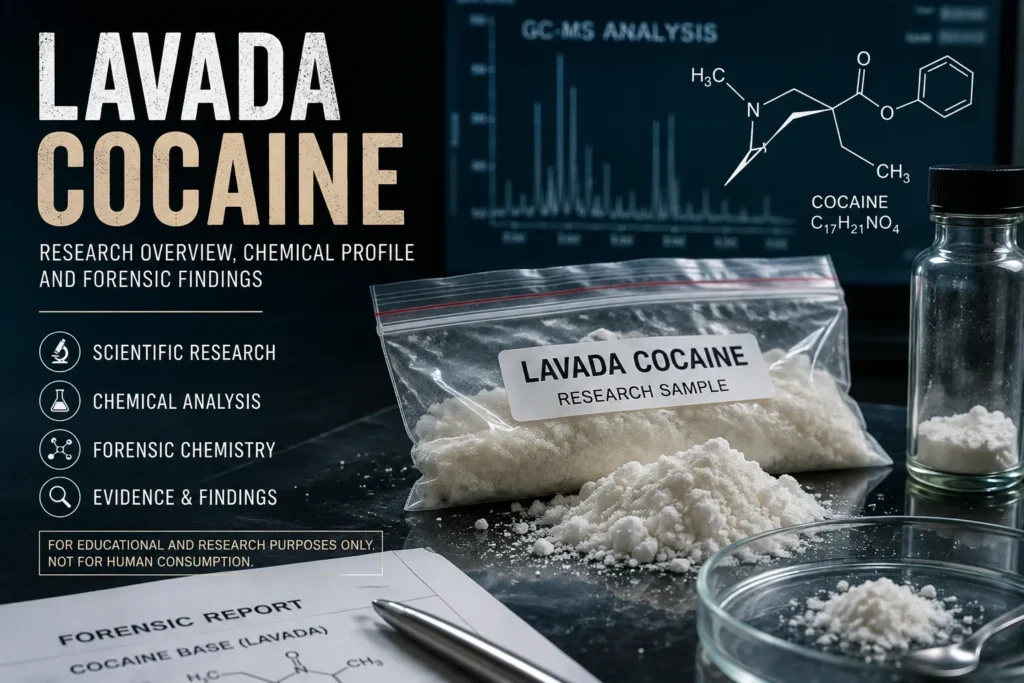
LAVADA Cocaine: Research Overview, Chemical Profile and Forensic Findings
Explore the scientific terminology, chemical profiling methods, forensic research, and published findings associated with LAVADA Cocaine.
What Is LAVADA Cocaine?
LAVADA Cocaine is a term associated with certain cocaine-base materials discussed in forensic and regional literature.
However, scientists do not recognize LAVADA as the standardized chemical name of one pure substance. Therefore, the term alone cannot establish a fixed molecular composition.
Why Does the Name Require Scientific Context?
Researchers use several related expressions when they describe cocaine-base materials. These expressions include base lavada, pasta lavada, and washed base.
As a result, researchers must consider the regional and forensic context before they interpret the term.
Why Does Laboratory Analysis Matter?
A product name provides contextual information. In contrast, laboratory analysis provides measurable information about the compounds in a sample.
Understanding the Term “Base Lavada”
The expression base lavada generally translates as “washed base.” Forensic and drug-market literature uses the expression when discussing certain cocaine-base materials.
Terminology can differ between countries. Therefore, researchers cannot assume that every sample described with the same term has identical chemistry.
How Do Researchers Interpret Regional Terminology?
Researchers first consider the geographic and forensic context. They then compare the terminology with analytical results from individual samples.
For example, a regional name may describe a product category without defining every compound within that category.
What Does the Term Tell Researchers?
The term can provide useful background information. However, it does not replace chemical testing.
Chemical Profile of LAVADA Cocaine
Forensic studies examine cocaine together with other compounds that may occur in analyzed samples.
These compounds can include minor alkaloids, processing-related constituents, and other chemical substances.
Why Do Scientists Examine Minor Compounds?
Minor compounds can provide useful chemical markers. In addition, their patterns can help researchers compare different samples.
What Can a Chemical Profile Show?
A chemical profile can show which compounds appear in a sample and how researchers can distinguish one analytical pattern from another.
Therefore, forensic scientists often examine several chemical characteristics instead of relying on a single compound.
What Has Published Research Found?
A study in the Journal of Forensic Sciences examined authentic Peruvian illicit cocaine-base and cocaine-hydrochloride exhibits.
The researchers used gas-chromatographic analysis to examine chemical profiles from the samples.
What Did the Researchers Identify?
The study identified several ethyl ester compounds in the chromatographic profiles of some authentic samples.
In particular, the researchers reported seven ethyl homologues of known tropane esters.
Why Do These Findings Matter?
These findings show how minor compounds can contribute to forensic chemical profiles.
Furthermore, the results demonstrate why researchers examine the wider chemical pattern rather than focusing only on the primary compound.
Reference: Casale JF, Boudreau DK, Jones LM. Journal of Forensic Sciences. 2008;53(3):661–667. PMID: 18471211.
How Do Researchers Analyze These Samples?
Researchers use analytical chemistry to identify and characterize compounds in forensic samples.
Gas Chromatography
Gas chromatography separates compounds within a sample. Scientists can then examine the resulting chromatographic pattern.
Mass Spectrometry
Mass spectrometry provides molecular information about detected compounds. Consequently, researchers can use this technique to support compound identification.
Combined Analytical Methods
Researchers can combine chromatography with mass spectrometry. This approach provides more information than either technique alone.
Why Do Researchers Compare Profiles?
Comparative analysis can reveal similarities and differences between samples. Therefore, forensic scientists can study chemical patterns across multiple exhibits.
Chemical Markers in Forensic Research
Forensic scientists can use minor compounds as potential chemical markers. These markers may provide information about the chemical characteristics of an analyzed sample.
How Do Chemical Markers Help Researchers?
Researchers can compare several markers at the same time. As a result, they can build a more detailed chemical profile.
Why Is One Compound Not Enough?
One compound may provide limited information. In contrast, a broader chemical pattern can provide a stronger basis for comparison.
What Does This Mean for Forensic Science?
This approach helps scientists study relationships between samples and investigate patterns in forensic datasets.
Why Can Samples Have Different Chemical Profiles?
Samples that share a regional name can still show different chemical characteristics.
What Factors Can Influence Chemical Profiles?
Researchers may consider geographic context, processing history, storage conditions, and other chemical constituents when they interpret analytical results.
Why Does Sample Variation Matter?
Sample variation prevents researchers from treating a regional product name as proof of identical chemistry.
For this reason, scientists examine individual analytical results before they draw broader conclusions.
Why Does Terminology Not Replace Testing?
A name can describe a market or regional category. However, only laboratory analysis can establish the measurable chemical characteristics of an individual sample.
LAVADA Cocaine in Forensic Chemistry
Forensic cocaine research extends beyond simple identification. Scientists can also compare chemical patterns between samples.
From Identification to Comparison
Analytical instruments can produce detailed chemical profiles. Researchers can then compare those profiles to identify similarities and differences.
How Does Forensic Intelligence Use Chemical Data?
Forensic researchers can combine chemical measurements with statistical analysis. This method can help scientists investigate patterns across sample collections.
Why Does This Research Matter?
Detailed chemical analysis can improve scientific understanding of cocaine-related samples. It can also support forensic research into chemical signatures.
What Are the Limitations of Current Research?
Research on LAVADA-related terminology has several limitations.
Terminology Can Vary
Different countries and sources may use different names for cocaine-related products. Therefore, researchers must evaluate terminology within its original context.
Studies Examine Specific Samples
Forensic studies usually examine particular sample groups. Consequently, researchers should not automatically apply one study's findings to every sample using the same name.
Laboratory Results Remain Essential
Researchers need analytical evidence to characterize an individual sample. Therefore, a product label cannot replace laboratory testing.
What Are the Scientific and Health Considerations?
Cocaine is a potent psychoactive stimulant. Scientific literature links cocaine exposure with serious cardiovascular, neurological, and psychological risks.
Why Does Chemical Research Not Establish Safety?
Chemical analysis can identify compounds and describe their characteristics. However, chemical identification does not establish medical safety.
Why Is Accurate Scientific Interpretation Important?
Researchers need reliable analytical evidence when they evaluate cocaine-related samples. For this reason, readers should distinguish forensic findings from medical claims.
Frequently Asked Questions
What is LAVADA Cocaine?
LAVADA Cocaine is a term associated with certain cocaine-base materials discussed in regional and forensic literature.
Is LAVADA a standardized chemical compound?
No. Scientists do not use LAVADA as the standardized chemical name for one pure molecular substance.
What does base lavada mean?
Base lavada generally means “washed base.” Researchers use the term in descriptions of certain cocaine-base materials.
Why do researchers study minor compounds?
Minor compounds can provide chemical markers. Therefore, researchers can use them when they compare analytical profiles.
How do scientists study these samples?
Researchers can use gas chromatography, mass spectrometry, and related analytical techniques to characterize chemical constituents.
Can a product name establish chemical purity?
No. A product name cannot establish the chemical composition or purity of an individual sample.
Final Research Perspective
LAVADA Cocaine is best understood as a regional and forensic term rather than a standardized chemical identity.
Published research shows that analyzed cocaine samples can contain cocaine together with minor chemical constituents.
What Does the Research Demonstrate?
Forensic studies demonstrate the value of detailed chemical profiling. In particular, researchers can examine tropane-related compounds and other minor constituents.
What Should Readers Remember?
The product name alone cannot establish a sample's composition. Instead, researchers rely on laboratory analysis and documented scientific methods.
Overall, LAVADA-related research provides a useful example of how forensic chemistry examines terminology, chemical markers, and sample variation.
Scientific References
Forensic Chemistry Literature
- Casale JF, Boudreau DK, Jones LM. Tropane ethyl esters in illicit cocaine. Journal of Forensic Sciences. 2008;53(3):661–667.
- United Nations Office on Drugs and Crime. Cocaine: A Spectrum of Products. UNODC Cocaine Insights.
- Lociciro S, Esseiva P, Hayoz P, Dujourdy L, Besacier F, Margot P. Research on cocaine chemical profiling and forensic intelligence.
- Dujourdy L, Besacier F. Research on chromatographic profiling of cocaine samples for forensic intelligence.
Educational Scope
This article summarizes forensic and scientific literature for educational purposes. It does not provide instructions for producing, processing, purchasing, or using cocaine.
This educational article explores the historical background, geography, scientific context, and legal framework surrounding Bolivian cocaine. The content is intended solely for educational purposes and does not encourage, promote, or provide guidance regarding illegal drug use or distribution.
What Is Bolivian Cocaine?
The term Bolivian cocaine is commonly used in news reporting, historical discussions, and academic literature to describe cocaine associated with Bolivia through production routes, trafficking history, or the country's connection to coca cultivation. It is important to distinguish between the coca plant, which has traditional and cultural uses in parts of the Andes, and cocaine, which is a refined controlled substance with significant legal and public health implications.
Educational discussions about Bolivian cocaine generally focus on the historical development of coca cultivation, the evolution of international drug-control policies, and the social, economic, and political factors that have influenced the region over many decades. These discussions are intended to improve understanding of history and public policy rather than to promote illegal activities.
Understanding the topic requires examining reliable historical records, scientific sources, and official reports. Many misconceptions arise when information from informal online sources is treated as fact, making evidence-based educational resources particularly valuable.
When studying Bolivian cocaine, it is helpful to separate discussions about the traditional coca plant, the chemistry of cocaine, historical developments, and modern legal frameworks. Considering these topics individually provides a more accurate and balanced understanding.
Why Is Bolivia Often Mentioned in Discussions About Cocaine?
Bolivia is frequently referenced in educational discussions because it is one of the Andean countries where the coca plant has been cultivated for centuries. The coca leaf has a long cultural and historical significance in parts of the Andes, particularly among Indigenous communities, where it has traditionally been used in lawful cultural practices that are distinct from the production of cocaine.
Modern discussions about Bolivian cocaine often examine the relationship between traditional coca cultivation, international drug-control policies, and the economic challenges faced by rural communities. Historians, economists, and policy researchers study these topics to better understand how geography, agriculture, and public policy have influenced the region over time.
Understanding this history requires separating traditional cultural practices involving the coca leaf from the illegal manufacture and trafficking of cocaine. Educational resources consistently emphasize this distinction because the two subjects are not the same from a historical, legal, or cultural perspective.
Many discussions about Bolivia focus on the historical importance of the coca plant, while separate legal and public policy discussions address the challenges associated with cocaine production and trafficking.
How Has Bolivian Cocaine Influenced International Drug Policy?
Educational discussions about Bolivian cocaine frequently examine its influence on international drug policy over the past several decades. Governments, international organizations, researchers, and public policy experts have studied the topic to better understand the social, economic, and security challenges associated with the illegal drug trade.
Throughout modern history, international cooperation has focused on reducing illegal trafficking, strengthening border security, improving law enforcement collaboration, and supporting public health initiatives. These efforts have also encouraged continued research into the broader economic and social factors that contribute to illegal drug markets.
Academic studies often emphasize that understanding Bolivian cocaine requires examining multiple perspectives, including history, economics, public health, agriculture, and international relations. Looking at the topic through only one perspective rarely provides a complete picture.
International drug policy continues to evolve as governments balance public health priorities, criminal justice approaches, economic development, and international cooperation.
What Are the Public Health Concerns Associated With Cocaine?
Public health organizations around the world identify cocaine as a controlled substance that carries significant health risks. Educational resources commonly explain that the effects of cocaine can vary depending on many individual factors, and misuse has been associated with serious physical, psychological, and social consequences.
Healthcare professionals and public health agencies encourage prevention, education, early intervention, and access to appropriate treatment services for individuals affected by substance use disorders. These approaches are widely recognized as important components of comprehensive public health strategies.
| Area | Educational Overview |
|---|---|
| Public Health | Focuses on prevention, education, and access to treatment services. |
| Research | Examines health, social, and economic impacts through scientific studies. |
| Policy | Combines legal measures with public health and community support initiatives. |
| Education | Encourages evidence-based information from reliable scientific and official sources. |
Understanding the public health dimension provides important context for discussions about Bolivian cocaine. Educational resources emphasize evidence-based information, prevention, and informed decision-making rather than myths or misinformation.
Frequently Asked Questions About Bolivian Cocaine
Why is Bolivia frequently mentioned in discussions about cocaine?
Bolivia is often discussed because it is one of the countries where the coca plant has traditionally been cultivated. Educational discussions usually examine the historical, cultural, agricultural, and political factors that have shaped the region over time while distinguishing these topics from the illegal production and trafficking of cocaine.
Is the coca plant the same as cocaine?
No. The coca plant is a naturally occurring plant with documented historical and cultural significance in parts of South America. Cocaine is a controlled substance derived through chemical processing and is subject to strict legal controls in many countries. Educational resources emphasize that these are separate subjects.
Why is it important to study the history of Bolivian cocaine?
Studying the historical background helps explain how geography, economics, public policy, and international cooperation have influenced events over time. Understanding this context allows readers to interpret news reports and historical developments more accurately.
Where can readers find reliable information about this topic?
Reliable information is available from academic publications, peer-reviewed research, public health organizations, universities, and official government resources. Comparing multiple reputable sources helps readers distinguish documented facts from unsupported claims.
Final Thoughts on Bolivian Cocaine
Educational discussions about Bolivian cocaine involve a combination of history, geography, public policy, economics, and public health. Examining these subjects together provides a broader understanding of why Bolivia is frequently mentioned in discussions relating to coca cultivation and international drug policy.
Approaching the topic through reliable educational sources encourages critical thinking and helps separate historical facts, scientific information, and legal frameworks from myths or misinformation. Readers who consult academic research, public health guidance, and official government publications are better equipped to understand this complex subject within its wider historical and social context.
This article is intended solely for educational purposes. It does not encourage or endorse illegal activities. Laws and public policies vary between jurisdictions, so readers should refer to official sources for current legal and public health information.
