
Buy ketamine
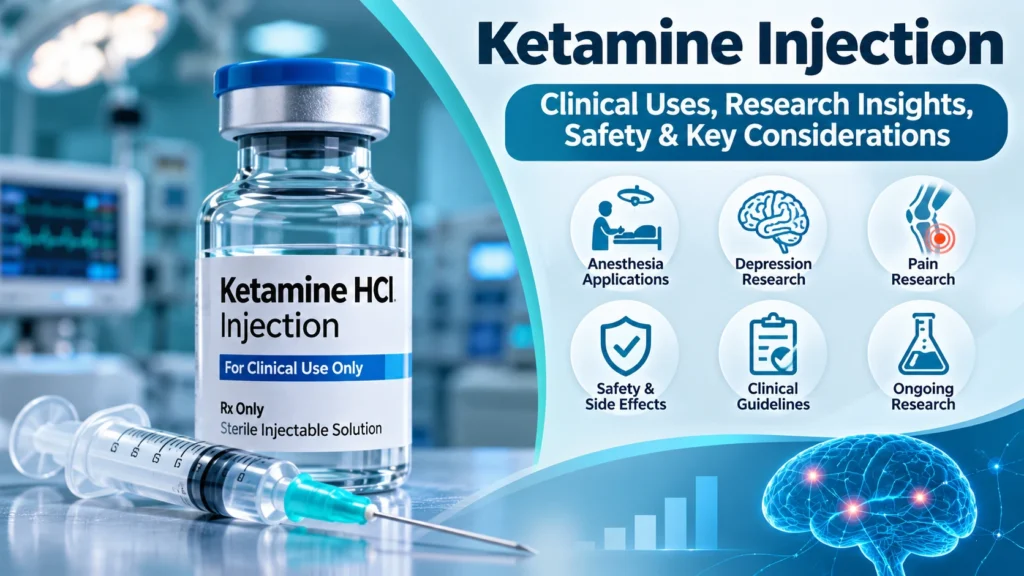
Ketamine Injection: Medical Uses, Research & Safety
Nov
Medical treatment continues to evolve as researchers explore different approaches to anesthesia, pain management, and complex neurological conditions. Among the medicines receiving considerable scientific attention is ketamine, an established anesthetic agent with a distinctive pharmacological profile. Its clinical history, effects on the central nervous system, and emerging research applications have made it an important subject in modern medicine.
A ketamine injection is primarily associated with anesthesia in clinical practice. However, scientific interest has expanded into other areas, including investigations into treatment-resistant depression and certain pain conditions. These developments have also created important questions about medical supervision, treatment suitability, possible adverse reactions, and long-term safety.
Understanding the difference between established medical applications and emerging research is essential. Although ketamine has several potential clinical applications, its use depends on the patient’s circumstances, professional assessment, and applicable medical regulations.
Understanding Ketamine and Its Place in Medicine
Ketamine is a medication that acts on the central nervous system. It is classified as a dissociative anesthetic and has been used in medical settings for decades. Unlike many traditional anesthetic agents, ketamine has distinctive effects on consciousness, pain perception, and certain neurological pathways.
One of its main pharmacological actions involves blocking N-methyl-D-aspartate (NMDA) receptors. These receptors are associated with glutamate, an important neurotransmitter involved in communication between nerve cells.
By influencing NMDA receptor activity, ketamine changes certain processes involved in perception, consciousness, and pain signalling. Researchers are also investigating how its interaction with glutamate pathways may contribute to its effects in depression-related research.
Ketamine hydrochloride injection is an established prescription anesthetic. Its clinical role should not be confused with every newer treatment being investigated under the broader term ketamine therapy.
How Ketamine Injection Is Used in Clinical Settings
The established medical role of ketamine injection is primarily related to anesthesia. According to official prescribing information, it has several applications in diagnostic and surgical environments.
| Clinical application | Medical context | Important consideration |
|---|---|---|
| General anesthesia | Used as an anesthetic agent for selected diagnostic and surgical procedures. | Requires qualified medical supervision. |
| Induction of anesthesia | Used in clinical settings as part of an anesthetic approach. | Patient condition influences clinical decisions. |
| Anesthetic supplementation | Used alongside other anesthetic medicines. | Requires assessment of potential drug interactions. |
| Depression research | Investigated in selected clinical studies. | Research findings do not establish routine approval for this indication. |
| Pain-related research | Studied in certain complex pain conditions. | Evidence and clinical recommendations vary. |
The first three applications are identified in official prescribing information. Depression and pain-related applications require separate consideration because research into a possible use does not automatically establish an approved indication.
Why Ketamine Has Attracted Scientific Interest
One reason ketamine remains an important subject in medical research is its influence on glutamate signalling.
Many traditional antidepressant medicines primarily affect neurotransmitter systems such as serotonin and norepinephrine. Ketamine has a different pharmacological profile, which has encouraged researchers to investigate whether it may influence certain symptoms through alternative neurological pathways.
Research has examined its relationship with synaptic plasticity, neuronal communication, and brain networks associated with mood regulation.
However, the biological mechanisms are complex. Scientists continue to investigate how different neurological processes contribute to the observed effects and why individual patients may respond differently.
This distinction matters because a scientifically interesting mechanism does not automatically establish a safe or effective treatment for every condition.
Ketamine Injection Therapy and Depression Research
Ketamine injection therapy is frequently discussed in medical research concerning treatment-resistant depression. This condition generally describes depression that has not responded adequately to multiple conventional treatment approaches.
Researchers have investigated whether ketamine may produce relatively rapid changes in certain depressive symptoms under controlled clinical conditions.
Some studies have reported improvements following medically supervised administration. Nevertheless, results vary, and the available evidence has limitations involving study size, duration, patient selection, and research methodology.
It is also important to distinguish ketamine from esketamine. Although both are related, they are not interchangeable medicines. Esketamine has its own regulatory status and treatment requirements in certain countries.
The evidence surrounding ketamine injection for depression should therefore be interpreted carefully. It remains an area of clinical investigation rather than a reason for unsupervised treatment.
What Published Research Says About Ketamine and Depression
A Cochrane review examined ketamine and other glutamate receptor modulators in adults with depression. The review included studies involving people with treatment-resistant depression.
For ketamine, the researchers reported an odds ratio of 3.94 for response or remission compared with placebo at the 24-hour assessment point. However, the authors rated the evidence as very low certainty.
This finding is scientifically interesting, but it should not be interpreted as a guarantee that a particular percentage of patients will improve. An odds ratio is not the same as a percentage response rate.
The limited certainty also means that further high-quality research is needed before drawing strong conclusions about long-term outcomes.
Research-Based Chart: Ketamine Compared With Placebo
Chart: Reported odds ratio for response or remission at 24 hours
Comparison reported in a Cochrane review of ketamine research in adults with depression.
1.00
3.94
Studies: 7
Total participants: 185
Evidence certainty: Very low
The bars show odds ratios, not percentages of patients who responded to treatment.
Chart interpretation: The odds ratio was higher in the ketamine group than in the placebo group in the included studies. However, the wide confidence interval and very low certainty mean that the result should be interpreted cautiously.
Chart placement: Keep this chart immediately after the research explanation and before the next section, “The Difference Between Established Uses and Emerging Applications.”
The Difference Between Established Uses and Emerging Applications
A common source of confusion in discussions about ketamine is the difference between established clinical indications and emerging research applications.
Its established anesthetic role is supported by official prescribing information. By contrast, research involving depression and other psychiatric conditions has developed through clinical studies with different treatment protocols and regulatory considerations.
The distinction is particularly important when discussing ketamine injection treatment.
A medicine may demonstrate promising results in a clinical trial without becoming an approved treatment for every condition investigated. Regulatory approval depends on the available evidence, safety evaluation, and the requirements of the relevant health authority.
Medical professionals must also consider whether a particular treatment is appropriate for an individual patient rather than relying only on general research findings.
Ketamine Injection Side Effects and Safety Considerations
Like other anesthetic medicines, ketamine can produce adverse reactions. Their nature and severity depend on several factors, including the patient’s health, other medicines, and the clinical circumstances.
Official prescribing information identifies several important safety concerns.
| Safety concern | Possible clinical effects |
|---|---|
| Cardiovascular changes | Increased or decreased blood pressure and heart rate. |
| Recovery reactions | Confusion, agitation, or emergence reactions. |
| Respiratory complications | Respiratory depression or apnea in certain circumstances. |
| Neurological effects | Changes in perception, muscle tone, or neurological activity. |
| Gastrointestinal effects | Nausea and vomiting. |
| Liver-related complications | Drug-induced liver injury. |
| Urinary complications | Bladder and urinary tract problems reported with prolonged misuse. |
Not every reaction occurs in every patient. Some reported adverse effects also have uncertain frequency because postmarketing reports do not always provide a reliable denominator.
Why Medical Monitoring Matters
Ketamine hydrochloride injection requires administration by, or under the direction of, medical professionals experienced in general anesthesia.
The official label emphasizes monitoring vital signs and cardiac function. Appropriate airway management, oxygenation, ventilation, and emergency equipment are also important parts of the clinical environment.
These precautions are necessary because cardiovascular changes, respiratory complications, and recovery-related reactions may require prompt medical attention.
Ketamine should not be treated as an ordinary medicine suitable for unsupervised administration.
Factors That Influence Clinical Assessment
Before considering any anesthetic medicine, healthcare professionals assess several aspects of a patient’s medical history.
- Existing cardiovascular conditions.
- Blood pressure history.
- Previous reactions to anesthetic medicines.
- Current prescription medicines.
- Relevant neurological conditions.
- Liver function and other medical concerns.
- Pregnancy status where applicable.
The assessment helps clinicians evaluate potential risks and identify circumstances in which a medicine may be unsuitable.
For example, official ketamine prescribing information identifies situations in which a significant increase in blood pressure could create a serious medical hazard.
Medication interactions are another important consideration. Combining ketamine with certain central nervous system depressants can increase the risk of profound sedation and respiratory complications.
Understanding the Difference Between Ketamine HCl and Other Formulations
Ketamine hydrochloride is the salt form used in several prescription formulations. The term ketamine HCl injection refers to an injectable pharmaceutical preparation containing ketamine hydrochloride.
The terminology may appear in clinical publications, prescribing information, and pharmaceutical references.
However, formulation names alone do not establish that different products are interchangeable. Pharmaceutical products may have different concentrations, excipients, packaging, regulatory approvals, and instructions.
Healthcare professionals must consult the applicable official product information rather than assuming that products with similar names have identical characteristics.
The same principle applies to the terms injectable ketamine and ketamine injectable. These expressions may appear in general medical discussions, but they should not be used as substitutes for verified pharmaceutical specifications.
Current Research and the Future of Ketamine-Based Treatments
Scientific interest in ketamine continues because researchers are examining its effects beyond its established anesthetic applications.
Depression research is one of the most visible areas. Studies have explored how ketamine affects glutamate signalling, neuronal communication, and changes in brain activity associated with mood.
Other investigations have considered its potential role in selected pain-related conditions. However, the quality of evidence differs between research areas, and findings from one condition cannot automatically be applied to another.
Future studies will need to address several important questions:
- How durable are the reported clinical effects?
- Which patients are most likely to benefit?
- What are the long-term safety considerations?
- How should treatment outcomes be measured?
- Which regulatory and clinical standards should apply?
Larger and better-designed studies can help clarify these questions. Until then, clinical decisions should remain grounded in established evidence and professional medical judgment.
Frequently Asked Questions
What is ketamine injection?
Ketamine injection is a prescription anesthetic medicine used in selected diagnostic and surgical procedures. It acts on the central nervous system and affects NMDA receptor activity.
What are the established ketamine injection uses?
Official prescribing information identifies its use as a sole anesthetic agent for selected procedures, for induction of anesthesia, and as a supplement to other anesthetic agents.
What is ketamine HCl injection?
Ketamine HCl injection is an injectable pharmaceutical formulation containing ketamine hydrochloride. Its use is governed by official prescribing information and applicable medical regulations.
Is ketamine injection used for depression?
Ketamine has been investigated in clinical research involving treatment-resistant depression. However, the evidence, regulatory status, and treatment requirements differ from its established anesthetic indications.
What are the possible ketamine injection side effects?
Reported adverse reactions include cardiovascular changes, nausea, vomiting, emergence reactions, respiratory complications, and certain neurological effects.
Why does ketamine require medical supervision?
Ketamine can affect cardiovascular function, consciousness, and breathing. Professional monitoring helps identify and manage complications in a controlled clinical environment.
Is ketamine the same as esketamine?
No. They are related but distinct medicines. Their formulations, regulatory status, and clinical applications should be considered separately.
What does research say about ketamine injection therapy?
Clinical studies have investigated ketamine in treatment-resistant depression and other conditions. Findings are promising in some areas, but evidence certainty and long-term outcomes remain important considerations.
Final Perspective
Ketamine remains an important medicine in modern anesthesia and an active subject of scientific research. Its established clinical applications are supported by prescribing information, while newer investigations into depression and other conditions require careful interpretation.
Understanding ketamine injection means looking beyond its pharmacological properties and considering the broader medical context, including patient assessment, clinical evidence, possible adverse reactions, and professional supervision.
Reliable medical information should always distinguish established indications from experimental or emerging applications. This approach helps readers understand both the scientific interest surrounding ketamine and the responsibilities involved in its clinical use.
Medical information notice: This article is educational and does not replace professional medical advice, prescribing information, or assessment by a qualified healthcare professional.
